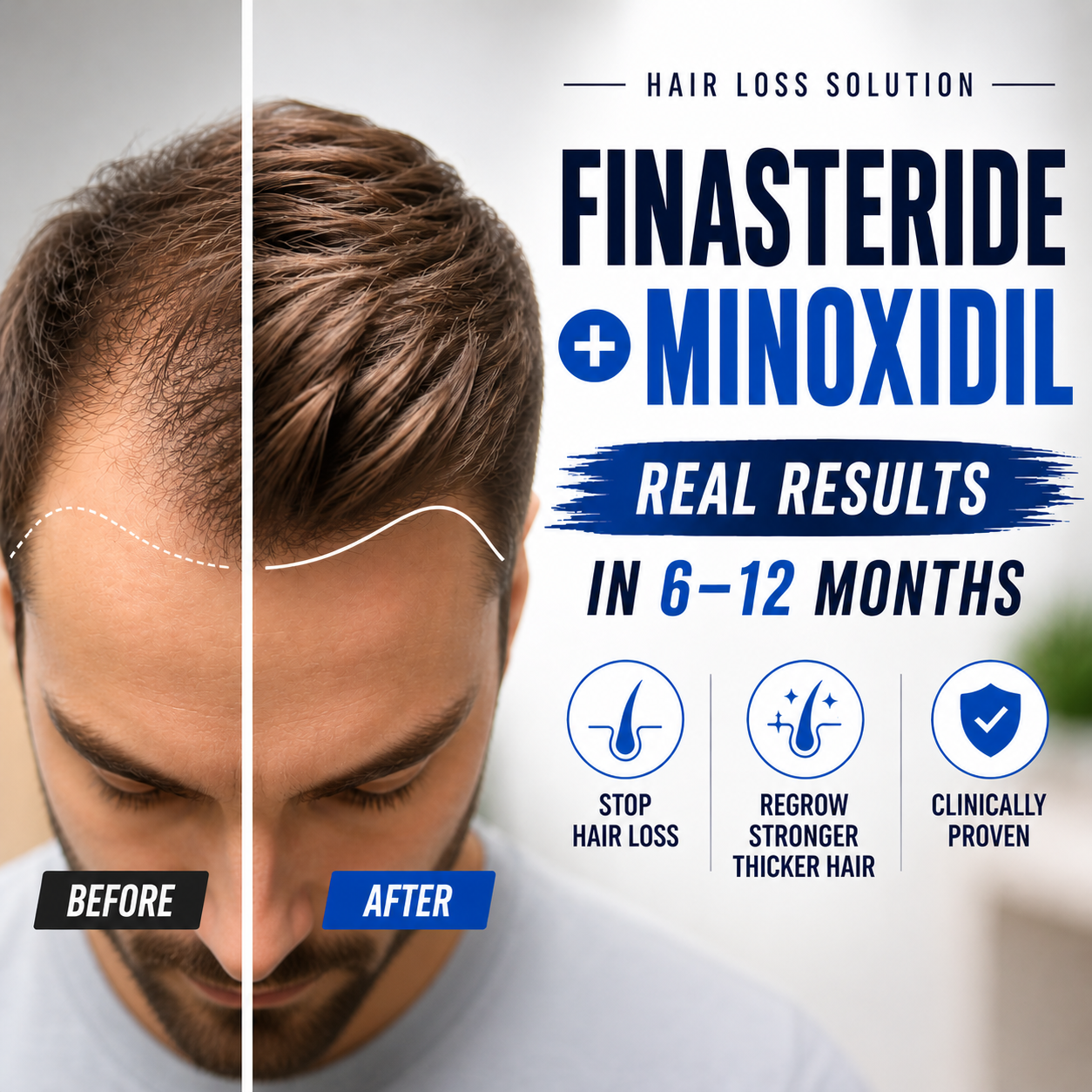
Hair loss treatment has evolved from single-drug approaches into multi-mechanism strategies, and nowhere is this more evident than in the combination of finasteride and minoxidil. While each drug independently offers measurable benefits, the real breakthrough lies in how they complement each other biologically, temporally, and clinically.
This isn’t just about “using two treatments.” It’s about targeting hair loss from both the root cause and the growth cycle simultaneously.
1. Mechanistic Synergy: Why the Combination Works Better
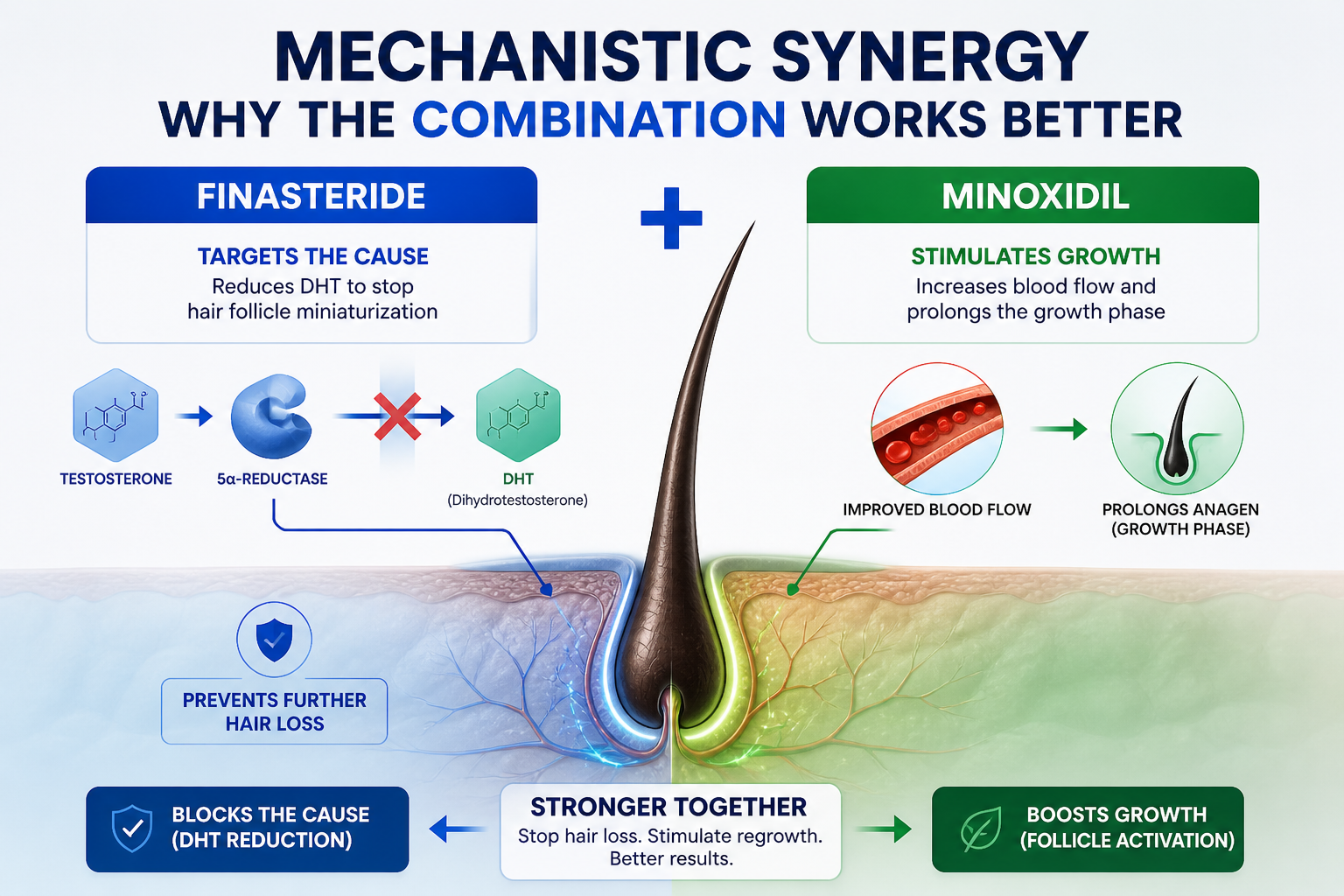
At the core of androgenetic alopecia lies dihydrotestosterone (DHT)—the hormone responsible for follicular miniaturization.
- Finasteride acts upstream by inhibiting 5-alpha reductase, reducing DHT production and protecting follicles from further damage
- Minoxidil, on the other hand, works downstream by stimulating blood flow and prolonging the anagen (growth) phase of hair
This creates a two-layer effect:
| Mechanism | Function |
|---|---|
| Finasteride | Stops ongoing follicle damage |
| Minoxidil | Stimulates regrowth and thickening |
Individually, each drug has limitations:
- Finasteride is better at stopping loss than regrowing aggressively
- Minoxidil promotes growth but does not address DHT
Together, they close each other’s gaps—which is why studies consistently show “significantly improved outcomes” when combined
2. Timeline Reality: What Actually Happens (Month-by-Month)
One of the biggest misconceptions is expecting fast cosmetic results. The reality is more nuanced.
Phase 1: 0–3 Months → Invisible Repair Phase
- Finasteride begins lowering DHT immediately
- Follicles start recovering function
- Minimal visible change (but internal stabilization begins)
- Some users may notice reduced shedding
This phase is deceptive—many quit here, but this is where the foundation is built
Phase 2: 3–6 Months → Early Visual Signals
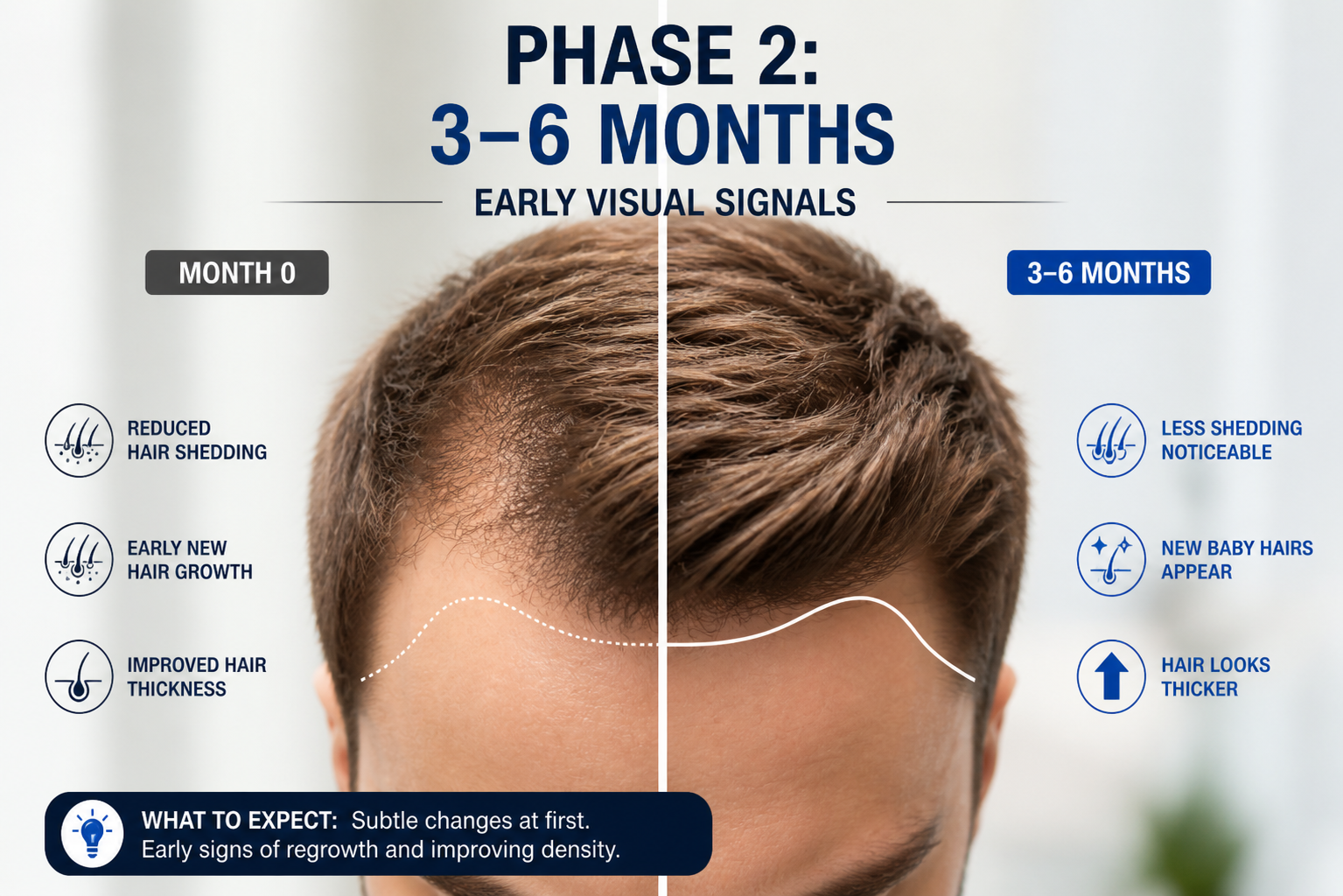
- Hair loss slowdown becomes noticeable
- Slight regrowth at hairline or thinning zones
- Hair strands appear thicker
This is the first point where users realize:
“Something is actually happening.”
However, growth is still inconsistent and subtle.
Phase 3: 6–12 Months → Compounding Effect
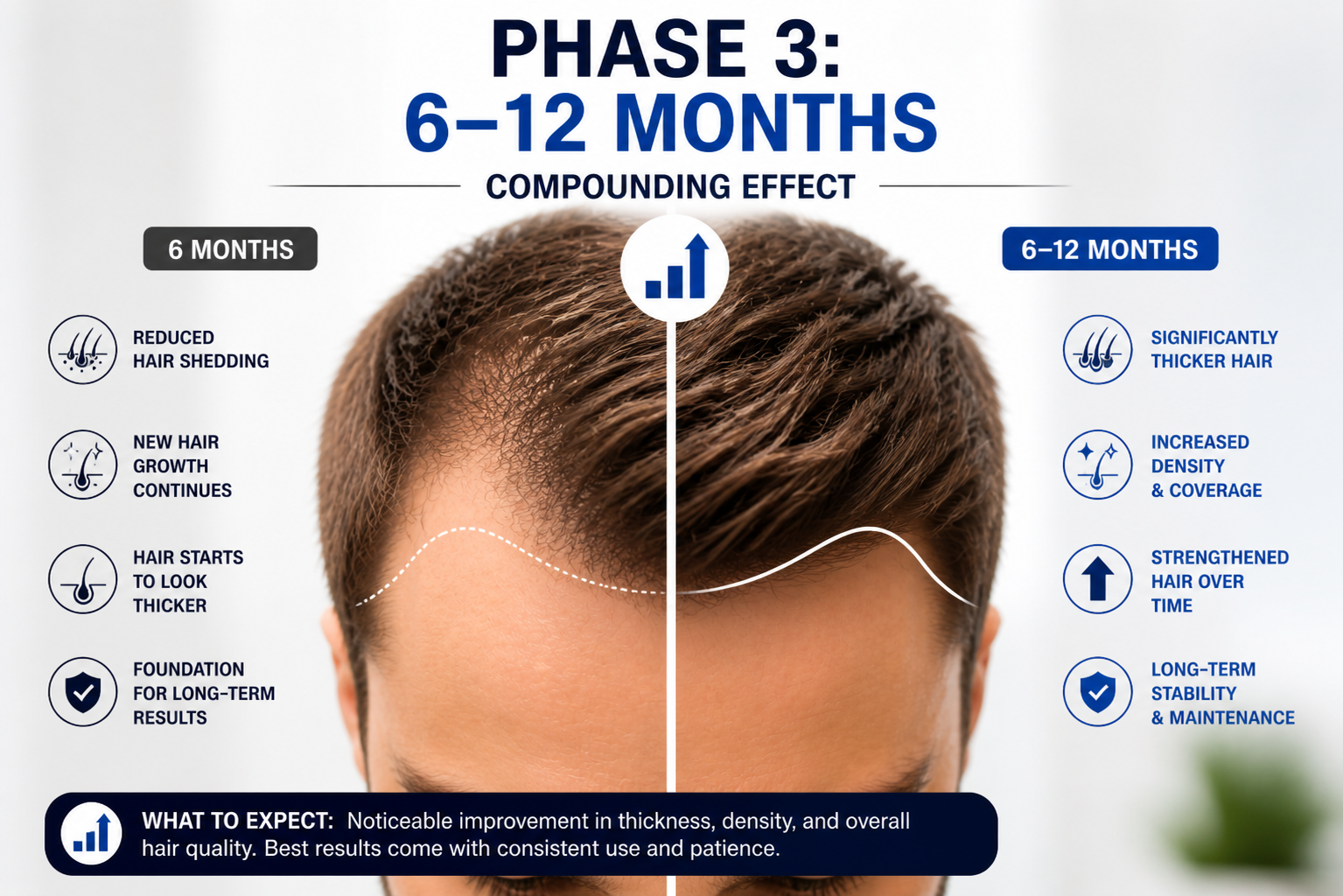
- Follicles produce stronger, thicker hair
- Density visibly improves
- Before/after differences become clear
By this stage:
- ~90% of users experience slowed hair loss
- ~66% see some degree of regrowth
This is where combination therapy begins to outperform monotherapy significantly.
Phase 4: 12+ Months → Maximum Efficiency Window
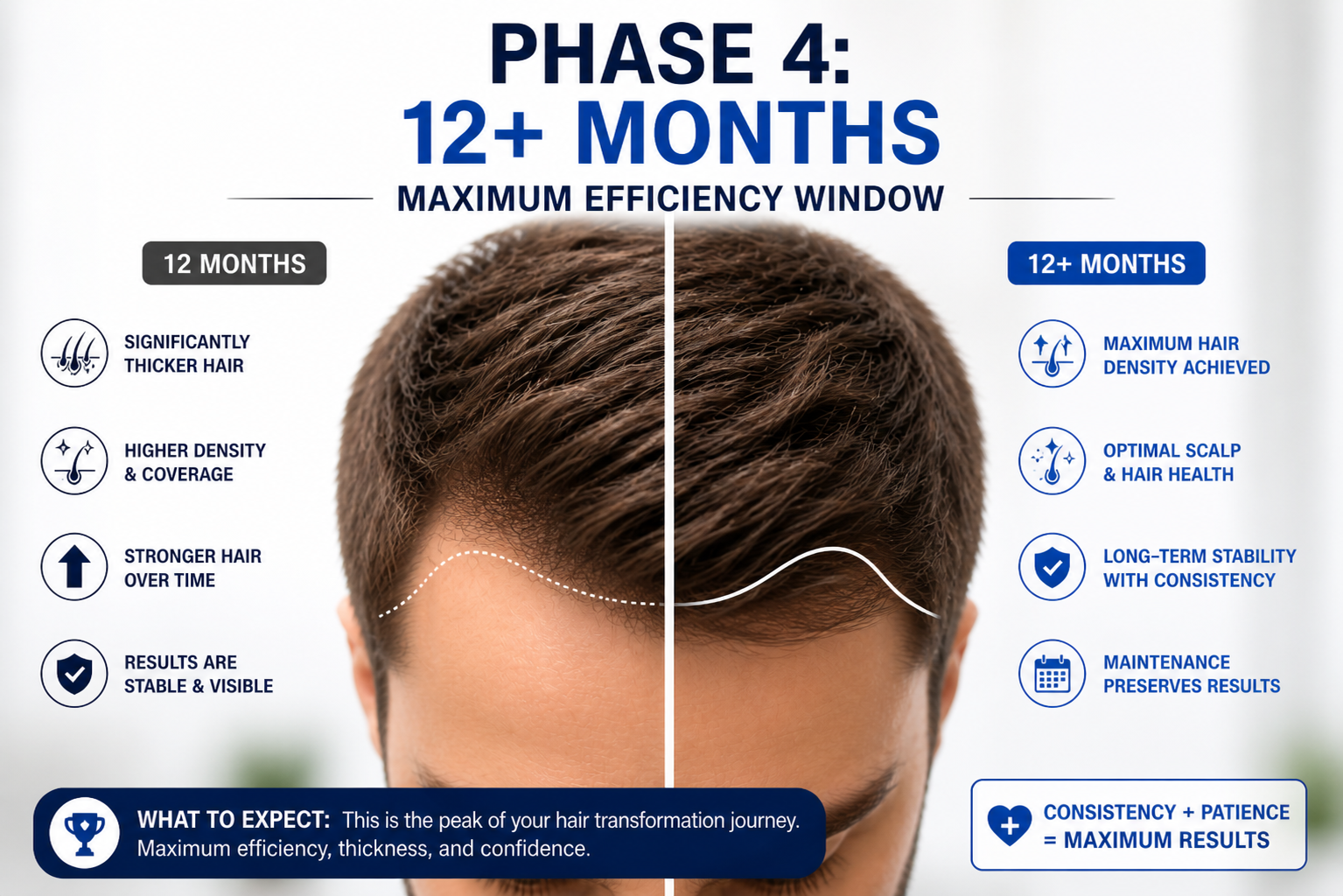
- Continued regrowth from previously dormant follicles
- Long-term density improvement
- Stabilization of hair loss progression
Important insight:
Hair regrowth is not linear—it compounds over time, especially when both drugs are used consistently.
3. Region-Specific Performance: Hairline vs Crown
The references highlight an important nuance most people miss:
- Finasteride excels at restoring the hairline
- Minoxidil performs better at crown/vertex regrowth
This creates a geographic synergy on the scalp:
- Hairline recession → primarily DHT-driven → finasteride dominant
- Crown thinning → more responsive to stimulation → minoxidil dominant
The combination therefore delivers full-scalp coverage, rather than partial improvement.
4. Oral vs Topical Strategy: Optimization Layer
Another layer of sophistication comes from formulation choices.
Oral Finasteride
- Systemic DHT reduction
- Stronger overall efficacy
- Small risk (~2–3%) of sexual side effects
Topical Finasteride (often combined with minoxidil)
- Local scalp DHT inhibition
- Minimal systemic exposure
- Slightly lower systemic risk
Key insight:
Most modern topical finasteride products are already combined with minoxidil by design, reinforcing the idea that combination therapy is becoming the default standard.
5. The Critical Rule: Continuity
This is non-negotiable.
- Finasteride must be taken continuously
- Stopping leads to:
- DHT rebound within 4–6 months
- Gradual loss of regained hair
Same with minoxidil:
- Gains are maintenance-dependent
This is not a “treatment”—it’s a management system.
6. Real-World Outcome Expectation (No Hype)
Based on both references:
What you can realistically expect:
- Hair loss slowdown: ~90% probability
- Regrowth: moderate, not full restoration
- Best results: early-stage users with active follicles
What you should NOT expect:
- Full reversal of advanced baldness
- Immediate visible results
- Permanent cure after stopping
The key phrase is:
“Revive dormant follicles—not dead ones.”
7. Strategic Takeaway (Most Important Part)
The combination of finasteride + minoxidil works because it aligns with the biology of hair loss:
- Block the cause (DHT)
- Stimulate the cycle (growth phase)
This dual-action model transforms treatment from:
- Passive prevention → into → active recovery + prevention
Final Conclusion
Finasteride alone can stabilize hair loss.
Minoxidil alone can stimulate regrowth.
But together, they create something more powerful:
A self-reinforcing cycle where follicles are both protected and activated.
That’s why combination therapy consistently delivers:
- Faster visible improvements
- Higher density outcomes
- Better long-term retention
In practical terms:
If you’re serious about hair recovery, monotherapy is outdated thinking.
The modern baseline is combination—and everything else is optimization on top of it.