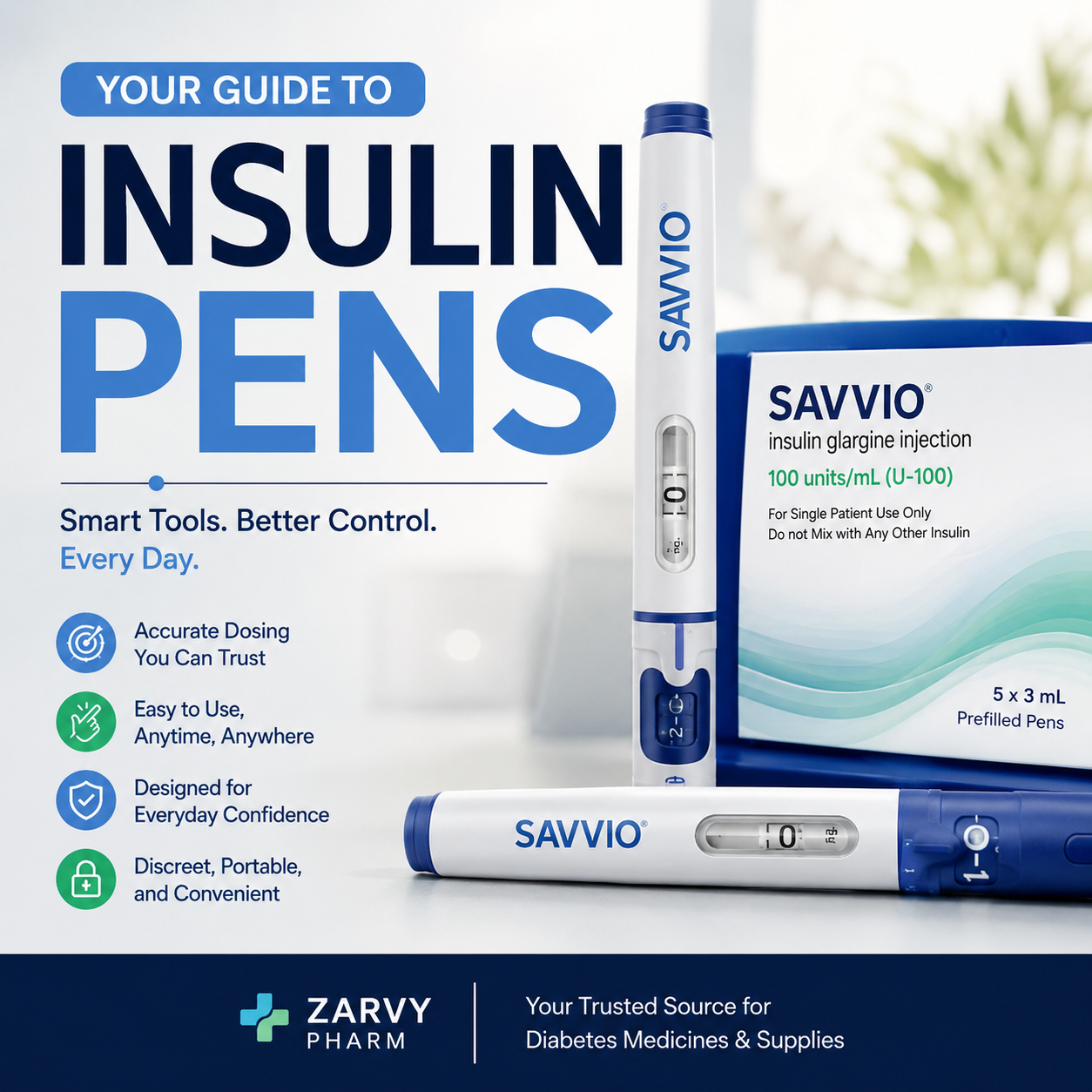
For millions of people living with diabetes, insulin is part of everyday life. While insulin was traditionally administered using a vial and syringe, insulin pens have become one of the most convenient and widely used ways to take insulin.
Compact, discreet, and relatively simple to operate, an insulin pen can make daily injections easier both at home and while traveling. But not every insulin pen is the same. Concentration, dose increments, maximum doses, needle sizes, and injection technique can all vary.
In this Zarvy Pharm guide, we'll explain how insulin pens work, the differences between common insulin concentrations, how to choose and use pen needles, and what to do when something doesn't seem right.
What Is an Insulin Pen?
An insulin pen is a handheld injection device designed to deliver insulin into the subcutaneous tissue beneath the skin.
As the name suggests, it resembles a large writing pen. Instead of ink, however, the device contains insulin. The user selects the prescribed number of insulin units using a dose dial and administers the dose through a small disposable needle.
There are generally two types:
Disposable insulin pens come prefilled with insulin and are discarded when the insulin has been used or the pen reaches its recommended in-use limit.
Reusable insulin pens use replaceable insulin cartridges. The pen body itself can be used repeatedly, while the cartridge and needle are replaced when necessary.
Some newer reusable pens also include digital or "smart" features that can help record insulin doses and injection times.
Understanding the Parts of an Insulin Pen
Although designs vary between manufacturers, most insulin pens contain several basic components.
The pen body houses the insulin delivery mechanism, while a cap protects the cartridge area when the pen is not being used.
Inside the pen is an insulin cartridge or reservoir. A rubber seal at the needle end helps keep the insulin contained until a needle is attached.
At the opposite end, the dose selector or dial allows the user to choose the prescribed number of units. The selected amount appears in the dose window.
When the injection button is pressed, the internal mechanism advances and delivers insulin through the attached pen needle.
Despite the simple appearance, these components are designed to work together with considerable dosing precision.
Insulin Pen Concentrations: U-100, U-200, U-300 and U-500
One of the most important specifications to understand is insulin concentration.
The "U" number tells you how many units of insulin are contained in one milliliter of solution.
U-100 Insulin
U-100 contains:
100 units of insulin per mL
This remains the standard concentration for many insulin products and is commonly prescribed worldwide.
A typical 3 mL U-100 prefilled pen therefore contains:
300 total units of insulin.
U-200 Insulin
U-200 contains:
200 units/mL
This provides twice as many units of insulin within the same volume compared with U-100.
Concentrated insulin can be useful when larger doses are required because the prescribed number of units can be delivered using a smaller volume of liquid.
Importantly, with modern dedicated insulin pens, patients normally select the prescribed number of units directly on the dose counter. The dose should not be manually converted simply because the insulin is more concentrated.
U-300 Insulin
U-300 contains:
300 units/mL
It provides three times the concentration of U-100 insulin.
Certain long-acting basal insulin formulations use this concentration. The higher concentration allows a given number of units to be delivered in a smaller injection volume, although the pharmacokinetic characteristics of individual insulin formulations also differ.
U-500 Insulin
U-500 contains:
500 units/mL
This is a highly concentrated insulin formulation generally intended for people who require very large daily insulin doses.
U-500 insulin has dosing and pharmacokinetic characteristics that differ substantially from standard U-100 insulin products. It should therefore be treated as a distinct insulin formulation rather than simply as "stronger U-100."
How Many Units Does an Insulin Pen Contain?
The total amount of insulin in a pen depends on both its concentration and cartridge volume.
For example, a standard 3 mL U-100 pen contains:
100 units/mL × 3 mL = 300 units
However, insulin pens do not all contain the same volume.
Some higher-capacity or concentrated pens contain significantly more total units while remaining compact enough for everyday use.
Always check the product label rather than assuming that every insulin pen contains 300 units.
Dose Increments and Maximum Doses
Another difference between insulin pens is how precisely the dose can be adjusted.
Many standard pens allow doses to be selected in 1-unit increments.
Certain pens designed for people requiring finer dose adjustment may allow half-unit increments.
Some concentrated insulin pens use larger increments, such as 2 units or more.
Pens also have a maximum amount that can be delivered in a single injection. Depending on the specific device, this may range from several dozen units to considerably higher amounts.
For this reason, two insulin pens containing similar types of insulin may still have very different dosing characteristics.
The specific pen's instructions should always be checked when switching devices.
What Is an Insulin Pen Needle?
The insulin itself is stored inside the pen, but a separate pen needle is normally attached for each injection.
These needles are extremely small compared with many traditional injection needles.
A typical pen needle consists of a very fine hollow metal needle surrounded by a protective plastic housing that screws or clicks onto a compatible insulin pen.
Pen needles are intended for single use.
Using a fresh needle for each injection helps maintain needle sharpness, reduces contamination risk, and lowers the chance of a blocked or damaged needle interfering with insulin delivery.
Used needles should be placed into an appropriate sharps disposal container.
Understanding Pen Needle Length and Gauge
Pen needles are available in several lengths and thicknesses.
Common lengths range approximately from:
4 mm to 12.7 mm
Needle thickness is described using gauge (G).
Common insulin pen needles may range from approximately:
29G to 34G
One potentially confusing point is that a higher gauge number means a thinner needle.
For example, a 32G needle is thinner than a 29G needle.
Are Shorter Insulin Needles Better?
For many adults and children, modern short pen needles—particularly around 4 mm—can effectively reach subcutaneous tissue while reducing the likelihood of accidentally injecting insulin into muscle.
Having a larger body size does not automatically mean that a longer needle is required.
Technique still matters, however. Needle length, injection angle, injection site, and individual circumstances can influence how an injection should be performed.
Longer needles may require a skinfold technique to reduce the possibility of intramuscular injection.
How to Use an Insulin Pen
Exact instructions vary between insulin products and pen designs, so the manufacturer's instructions for the specific pen should always take priority.
The general process usually looks like this:
- Check the insulin.
Confirm that you have the correct insulin and inspect its appearance according to the product instructions. - Attach a new needle.
Remove the protective seal and securely attach the needle to the pen. - Prime the pen.
Before dosing, the pen is typically primed according to its instructions to confirm insulin flow and remove air from the needle. - Select the prescribed dose.
Turn the dose selector until the required number of units appears in the dose window. - Choose an appropriate injection site.
Insulin is commonly injected into subcutaneous tissue in areas such as the abdomen, thigh, or upper arm, depending on the insulin and instructions provided. - Insert the needle and inject.
Press the injection button completely and keep the needle in place for the period specified in the pen instructions to help ensure the complete dose has been delivered. - Remove and safely dispose of the needle.
Remove the needle from the pen after the injection and place it in an appropriate sharps container.
A new needle should normally be used for every injection.
Do You Need to Pinch the Skin?
Not necessarily.
The technique of gently lifting a fold of skin is sometimes called the skinfold technique.
Its purpose is to separate subcutaneous fat from the underlying muscle and reduce the chance that insulin is injected too deeply.
With modern short needles such as 4 mm pen needles, a skinfold is often unnecessary for many people when correct technique is used.
With longer needles or certain body types and injection sites, however, creating a skinfold may be appropriate.
Common Insulin Pen Problems
Insulin pens are designed to make injections straightforward, but several problems can occasionally occur.
1. Insulin Does Not Come Out
If insulin does not appear during priming or the injection button feels unusually difficult to press, the needle may be blocked or damaged.
Replace the needle with a new one and repeat the priming procedure according to the device instructions.
Never try to force a malfunctioning pen.
2. Bent or Damaged Needle
Needles can become bent through improper attachment, handling, or reuse.
Even when a used needle appears normal, its tip may have been damaged microscopically.
Using a new needle for every injection helps minimize this problem.
3. Wrong Dose Selected
Always check the dose window before injecting.
If you accidentally dial too many units before administering the injection, most insulin pens allow the dose selector to be turned back to the correct number without releasing insulin.
If an incorrect dose has already been injected, follow the appropriate instructions for that insulin and monitor accordingly.
4. Air Bubbles
Small amounts of air can sometimes appear inside the insulin reservoir.
Correctly priming the pen before an injection helps verify insulin flow and reduces problems associated with air in the needle system.
Do not attempt to remove air by manipulating or dismantling the cartridge.
5. Injection Site Lumps
Repeatedly injecting into exactly the same area can contribute to lipohypertrophy, where fatty tissue underneath the skin becomes thickened or lumpy.
Insulin injected into these areas may be absorbed less predictably.
Rotating injection sites rather than repeatedly using the same spot helps reduce this problem.
6. The Full Dose Will Not Inject
Resistance during injection can result from a blocked needle, incorrect attachment, or a problem with the pen mechanism.
A fresh needle and proper priming may resolve a needle-related issue.
If the device itself appears damaged or continues to malfunction, it should not be relied upon for accurate insulin delivery.
Insulin Pen Storage Matters
Insulin is sensitive to inappropriate temperatures.
Unopened insulin is generally stored under refrigeration within the temperature range specified by the manufacturer, while many insulin pens can be kept at controlled room temperature for a defined period after first use.
However, storage conditions and in-use expiration periods vary considerably between insulin products.
Insulin should not be frozen, and excessive heat or prolonged direct sunlight can damage it.
Always check the storage instructions for the exact insulin product being used rather than applying one storage rule to every insulin pen.
Traveling With Insulin Pens
One of the major advantages of insulin pens is portability.
When traveling, keep insulin protected from extreme temperatures and avoid leaving pens in places such as a hot vehicle.
For air travel, insulin and essential diabetes supplies are generally better kept with you rather than placed in checked baggage, where temperatures may be less predictable and luggage may be delayed or lost.
Carry enough needles and other necessary diabetes supplies for the expected duration of the trip, with additional supplies where practical.
Key Takeaways
Insulin pens offer a compact and convenient alternative to traditional vial-and-syringe insulin administration.
The most important points to remember are:
- Insulin pens are available in several concentrations, including U-100, U-200, U-300, and U-500.
- Concentrated insulin pens should be used according to their dedicated dose counters and product instructions rather than through manual dose-volume conversion.
- Pen capacity, dose increments, and maximum injection doses differ between products.
- Short pen needles are suitable for many people, and a larger body size does not automatically require a longer needle.
- A fresh pen needle should normally be used for each injection.
- Priming helps confirm insulin flow before administering a dose.
- Rotating injection sites can help prevent lipohypertrophy and inconsistent insulin absorption.
- Storage requirements and usable periods after opening differ between insulin products.
Understanding the specific insulin and pen device you use is just as important as understanding insulin pens in general.
At Zarvy Pharm, we aim to make information about diabetes medicines and supplies easier to understand, helping customers become more familiar with the products and devices involved in everyday diabetes management.