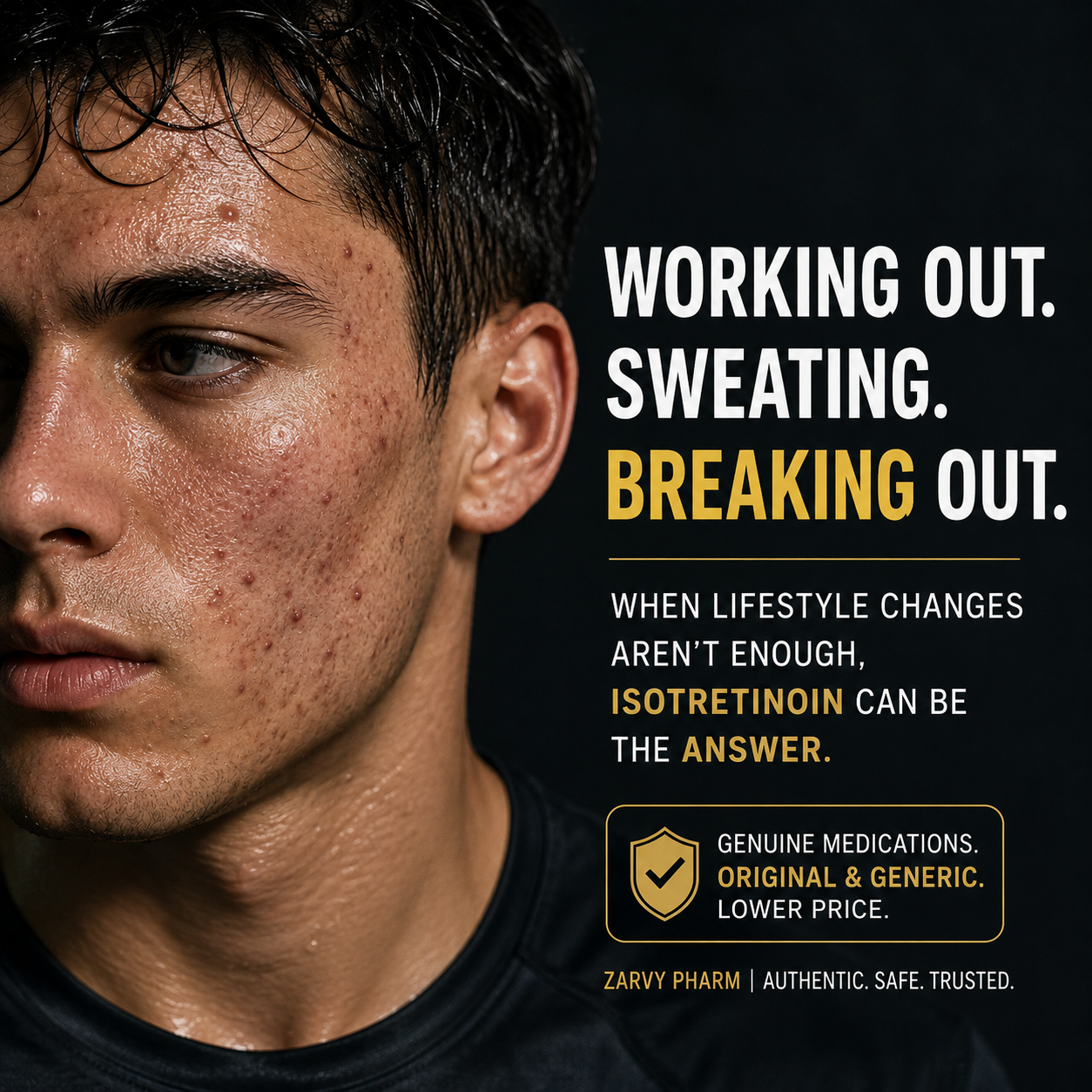
You increase your training intensity, start sweating more than usual, and everything seems to be going in the right direction.
Then your skin suddenly has other plans.
More pimples appear across your face. Your forehead gets especially bad. You wash your towels after every use, keep yourself reasonably clean, and haven't made any major changes to your diet or protein intake.
So why is your acne suddenly getting worse?
If this sounds familiar, the answer may have less to do with exercise itself and more to do with what happens to your skin during and after intense workouts.
More Intense Training Means a Different Environment for Your Skin
Exercise itself isn't something you should avoid because of acne.
The problem is that harder workouts often mean:
- More sweating
- More oil accumulating on the skin
- More frequent wiping of the face
- More heat and moisture against the skin
- More contact with gym equipment, towels, hair, and clothing
When several of these factors occur together, acne-prone skin may start breaking out much more aggressively.
This can be especially noticeable on the forehead, where sweat, sebum, hair, and hair-styling products can all come into contact with the skin.
You might therefore notice that your acne becomes significantly worse a few weeks after increasing your workout frequency or intensity, even though your diet and supplements haven't changed much.
The Clean Towel Problem: Clean Doesn't Mean Friction-Free
Here's something that's easy to overlook.
You can use a freshly washed towel every single workout and still irritate your skin.
Why?
Because the issue isn't necessarily bacteria on the towel. It can simply be how you're using it.
When you're sweating heavily, it's tempting to repeatedly rub your forehead and face with a towel. But repeated friction can irritate acne-prone skin and potentially make existing breakouts worse.
Instead of rubbing your face, gently pat or blot the sweat away.
It's a tiny change, but if you're wiping your face dozens of times during a hard workout, it can make a meaningful difference.
Pay Special Attention to Your Forehead
If your forehead is breaking out more than the rest of your face, take a look at what touches it throughout the day.
Hair wax, pomade, styling cream, conditioner, and other hair products may migrate onto the forehead, especially once you start sweating.
Combine that with increased perspiration during training and you have another potential trigger for clogged pores.
A simple experiment is to keep your hair away from your forehead while exercising and make sure styling products don't come into contact with acne-prone areas.
Do You Need to Stop Training Hard?
Usually, no.
If your breakouts appeared around the same time that you increased your training intensity, it makes more sense to improve your skin routine first rather than immediately sacrificing your workouts.
Start with the basics:
During exercise: Use a clean towel and pat sweat away rather than repeatedly rubbing your skin.
After exercise: Wash your face gently after heavy sweating with a mild, non-comedogenic cleanser.
Hair: Keep hair and oily styling products away from your forehead.
Skin care: Avoid aggressively scrubbing your face in an attempt to "clean out" acne. Irritating already inflamed skin can make matters worse.
Give these changes some time and watch whether the number of new breakouts begins to decrease.
But What If the Acne Keeps Coming Back?
This is where it's important to distinguish occasional workout-related breakouts from persistent or severe acne.
Some people continue developing inflammatory acne despite changing their skin-care habits and trying conventional acne treatments.
And for severe, deep, nodular, scarring, or treatment-resistant acne, one of the most established prescription options is isotretinoin.
What Is Isotretinoin?
Isotretinoin is an oral retinoid derived from vitamin A and is one of the most powerful medications used in the treatment of severe acne.
Unlike products that target only one aspect of acne, isotretinoin has profound effects on sebaceous glands and sebum production while also influencing clogged pores and inflammation.
This is why isotretinoin is generally positioned differently from everyday cleansers, spot treatments, or cosmetic acne products.
For appropriately selected patients with severe acne, treatment can produce substantial and long-lasting improvement.
You may also recognize isotretinoin by the famous former brand name Accutane. Accutane itself is no longer marketed in the United States, but isotretinoin remains available through other branded and generic products.
Original Brands vs. Generic Isotretinoin
One question customers frequently have is whether they need to pay more for a branded isotretinoin product.
Both branded and generic medicines contain isotretinoin as the active pharmaceutical ingredient when supplied as legitimate approved products. Depending on the manufacturer and market, differences can include formulation, inactive ingredients, capsule design, available strengths, packaging, and price.
For customers primarily concerned about cost, generic isotretinoin can provide a considerably more economical option than higher-priced branded products.
At Zarvy Pharm, we offer both branded and generic pharmaceutical options where available, allowing customers to compare products according to their preferences and budget.
For customers looking for a lower-cost option, generic isotretinoin is often the practical choice.
Zarvy Pharm handles only genuine pharmaceutical products sourced through our established supply channels. We do not intentionally sell counterfeit or imitation medicines.
Lower price does not have to mean choosing a counterfeit product.
It can simply mean choosing a genuine generic medicine instead of paying the premium associated with a particular brand.
Isotretinoin Is Not an Everyday Acne Supplement
This distinction matters.
Isotretinoin should not be treated like a casual supplement that you start simply because a few pimples appeared after a sweaty week at the gym.
It is a prescription medication primarily used for severe or treatment-resistant acne and requires appropriate medical assessment and monitoring.
Isotretinoin can cause significant dryness of the skin and lips and has other clinically important precautions and potential adverse effects. It is also strictly contraindicated during pregnancy because exposure can cause severe birth defects.
Patients using isotretinoin should follow the prescribing and monitoring requirements applicable in their country.
The Bottom Line
If your face suddenly starts breaking out after you dramatically increase your workout intensity, don't immediately assume that something is fundamentally wrong with your body.
Look at what changed.
You're sweating more.
You're probably wiping your face more frequently.
Your forehead may be spending more time in contact with sweat, hair, or styling products.
Start by removing those triggers:
Don't rub sweat aggressively with your towel. Pat it away.
Keep hair products away from your forehead.
Cleanse gently after sweating.
And don't try to scrub acne away.
For many people, controlling these seemingly minor habits can make a noticeable difference.
But when acne becomes persistent, deep, painful, scarring, or resistant to conventional treatment, the situation changes. That's when prescription treatments such as isotretinoin may become relevant.
For customers comparing isotretinoin products, Zarvy Pharm provides access to both branded and cost-effective generic options where available, with a focus on supplying genuine pharmaceutical products.
Sometimes the answer isn't to stop training.
It's to understand what's happening to your skin — and choose the appropriate level of treatment.