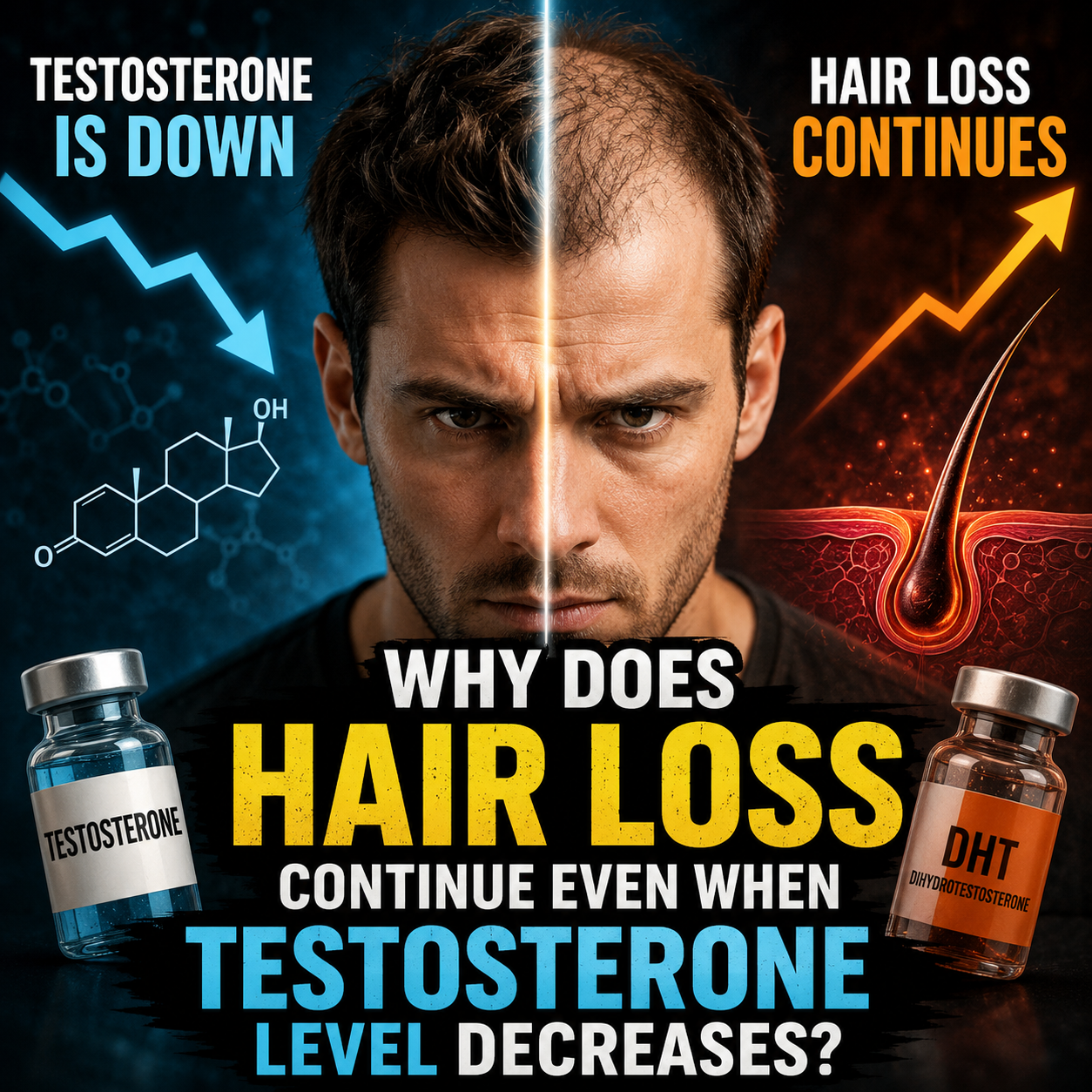
Here is something that confuses a lot of men.
You get older, your testosterone is not what it used to be, but somehow your hairline keeps moving in the wrong direction.
Then there is the opposite worry.
Maybe you train hard four or five times a week. You lift heavy, you feel stronger, and you have heard that intense exercise can increase testosterone.
So now you start wondering:
Is all this training making my hair loss worse?
And if you are already taking something like finasteride, there is another question that tends to pop up.
If finasteride reduces DHT, is it also lowering my testosterone and hurting my muscle growth?
These are all reasonable questions.
The problem is that testosterone and hair loss are usually explained in a way that is far too simple.
You have probably heard something like this:
More testosterone means more hair loss.
That sounds logical.
It is also not really how male pattern hair loss works.
To understand what is actually happening, we need to talk about testosterone, DHT, genetics and what is happening inside the hair follicle itself.
First, High Testosterone Does Not Automatically Mean Hair Loss
Testosterone obviously matters.
It is one of the major androgens in the male body and is involved in muscle mass, bone health, sexual function, red blood cell production and many other processes.
But your testosterone result on a blood test does not tell you whether you are going to lose your hair.
This is where things get interesting.
Research on androgenetic alopecia, the medical term for male pattern hair loss, has not consistently found that balding men simply have higher serum testosterone than men who keep their hair.
Endotext, for example, notes that studies comparing testosterone and free testosterone between men with androgenetic alopecia and controls have not shown consistent differences.
So you can have perfectly normal testosterone and still lose your hair.
You can also have relatively high testosterone and keep a great head of hair.
Why?
Because testosterone is only one part of the story.
The next part is DHT.
DHT Is Where Things Get More Interesting
DHT stands for dihydrotestosterone.
Your body produces DHT from testosterone through an enzyme called 5 alpha reductase.
Think of it like this:
Testosterone → 5 alpha reductase → DHT
Testosterone and DHT are related, but they are not the same hormone.
And when we are talking about male pattern hair loss, that difference matters a lot.
DHT interacts strongly with androgen receptors in susceptible scalp follicles.
Over time, this signaling can contribute to the gradual shrinking of those follicles.
That process is called follicular miniaturization.
The hair becomes thinner.
The growth phase becomes shorter.
The next hair may grow back finer than the previous one.
Eventually, some follicles produce hairs that are so small and thin that they become difficult to see.
This does not happen overnight.
It happens gradually across repeated hair cycles.
And this brings us to the first big question.
My Testosterone Is Lower Now. Why Am I Still Losing Hair?
This one actually makes much more sense once you stop thinking of hair loss as a direct testosterone meter.
Yes, testosterone commonly declines as men get older.
But that does not mean your scalp suddenly forgets everything that has happened during the previous twenty or thirty years.
If your follicles are genetically sensitive to androgen signaling, the miniaturization process may already have been developing for years.
Lower testosterone later in life does not automatically reverse that process.
There is another important point.
What is happening in your bloodstream and what is happening inside your scalp are not necessarily identical.
Hair follicles have their own local androgen environment.
The scalp contains enzymes involved in converting and metabolizing androgens, and follicles can differ in their sensitivity to those hormones.
Research has found differences involving DHT, androgen receptors and local androgen metabolism in balding scalp.
So simply saying:
My testosterone went down, therefore my hair loss should stop
misses a large part of the biology.
Your current testosterone level is only one variable.
Genetics Matter More Than Most People Realize
We have all seen this.
One guy seems to have everything that people associate with high testosterone.
He is muscular, grows a beard easily and has thick hair well into middle age.
Another guy starts losing his hair in his early twenties.
That does not necessarily mean the second guy has more testosterone.
His follicles may simply be more sensitive to androgen signaling.
That is why family history is so useful when thinking about male pattern hair loss.
The important question is not only:
How much testosterone do I have?
It is also:
How does my scalp respond to androgens?
Those are two very different things.
Okay, But What If I Train Really Hard?
This is where gym guys understandably start getting nervous.
Heavy squats.
Deadlifts.
Bench press.
Hard interval sessions.
High volume bodybuilding workouts.
Exercise can temporarily change several hormones, including testosterone.
So it is easy to make the following connection:
Hard training → More testosterone → More DHT → More hair loss
Fortunately, the body is not quite that simple.
A temporary change in testosterone after a workout is very different from having chronically elevated testosterone throughout the day.
Research looking at resistance training and testosterone has found that training does not necessarily produce a major long term increase in resting testosterone.
Your hormones move around after exercise.
That is normal physiology.
It does not mean every heavy leg session permanently pushes your testosterone and DHT into a new range.
So Can I Keep Lifting Without Worrying About My Hair?
If you are genetically prone to male pattern hair loss, it makes sense to pay attention to it.
But there is currently no good reason to assume that normal resistance training automatically causes baldness simply because exercise can temporarily affect testosterone.
This is an important distinction.
Training naturally and taking external androgens are not the same thing.
Someone doing heavy resistance training and experiencing normal hormonal responses is in a very different situation from someone introducing testosterone or anabolic steroids from outside the body.
External androgen exposure can create hormone levels and patterns that normal training simply does not produce.
For someone who is genetically susceptible to androgenetic alopecia, that distinction can matter.
So if you love lifting weights, the answer is not to stop training because you are scared of testosterone.
Exercise has far too many benefits for that conclusion to make sense based on the evidence we currently have.
Now Let's Talk About Finasteride
This is probably the biggest misunderstanding among men who care about both their hair and their physique.
You hear that finasteride reduces DHT.
Then you think:
DHT is an androgen. Testosterone is an androgen. If I reduce DHT, am I basically reducing my male hormones?
Not exactly.
Finasteride does not primarily work by shutting down testosterone production.
It inhibits 5 alpha reductase, the enzyme involved in converting testosterone into DHT.
Remember the pathway:
Testosterone → 5 alpha reductase → DHT
Finasteride interferes with that conversion.
That is very different from simply lowering testosterone.
Does Finasteride Lower Testosterone?
This is where the common gym myth starts falling apart.
If less testosterone is being converted into DHT, testosterone does not automatically decrease.
In fact, studies have observed that testosterone can remain stable or increase modestly during finasteride treatment.
That does not mean finasteride is a testosterone booster.
It is not.
It simply shows that lower DHT and lower testosterone are not the same thing.
This distinction is especially important for people who train seriously.
But Don't I Need DHT to Build Muscle?
DHT is a powerful androgen in some tissues.
So this is a fair question.
If you reduce DHT, could you reduce strength or muscle growth?
Human research gives us some useful clues here.
Studies examining testosterone treatment with and without finasteride have found that reducing DHT did not eliminate testosterone related increases in lean body mass and strength.
That tells us something important.
The androgen biology of skeletal muscle is not identical to the androgen biology of scalp hair follicles.
Your muscles and your hair do not respond to these hormones in exactly the same way.
This is really the key to understanding the whole subject.
The Same Hormone Can Mean Different Things in Different Tissues
Your body is not one giant testosterone receptor.
Different tissues contain different enzymes, receptors and signaling environments.
In skeletal muscle, testosterone plays an important role in maintaining muscle mass and supporting anabolic processes.
In genetically susceptible scalp follicles, DHT signaling can contribute to progressive follicular miniaturization.
That is why something can be beneficial or necessary in one tissue while producing a completely different effect somewhere else.
Once you understand this, the supposed contradiction between testosterone, muscle growth and hair loss becomes much easier to understand.
What If You're Getting Older and Still Losing Hair?
Your testosterone may be lower than it was at twenty five.
That does not mean androgenetic alopecia automatically stops.
Your follicles may already have undergone years of progressive miniaturization.
Your scalp may also remain sensitive to DHT and androgen receptor signaling even when your circulating testosterone is lower than it once was.
Age related testosterone decline therefore does not necessarily equal age related protection from hair loss.
What If You Train Hard and You're Worried About Testosterone?
Keep the difference between temporary hormonal changes and chronic androgen exposure in mind.
A hard workout can affect testosterone temporarily.
That does not mean you are walking around with permanently elevated testosterone because you train five times a week.
There is currently no convincing evidence that normal resistance training should be avoided simply to protect yourself from male pattern hair loss.
If you are genetically susceptible, monitor your hair.
But do not automatically blame the gym.
What If You Take Finasteride and Care About Muscle Growth?
Finasteride reduces the conversion of testosterone into DHT.
It does not simply switch off testosterone.
Available human evidence does not show that reducing DHT with finasteride automatically eliminates the muscle and strength effects associated with testosterone.
That is reassuring for people who care about both their hair and their training.
Of course, finasteride is still a medication.
Like any medication, it can cause adverse effects and it is not appropriate for everyone.
Questions about sexual function, fertility, existing medical conditions or other medications should be discussed with a healthcare professional.
But the idea that:
Finasteride lowers testosterone and therefore kills your gym progress
is far too simplistic.
So What Actually Matters for Hair Loss?
If you remember only one thing from this article, remember this:
Hair loss is not simply a reflection of how much testosterone is in your blood.
Testosterone matters because it is part of the androgen pathway.
But so do DHT, 5 alpha reductase, androgen receptors, genetics, local scalp metabolism and the sensitivity of individual hair follicles.
That explains why two men with similar testosterone levels can have completely different hair.
It explains why hair loss can continue even as testosterone naturally declines with age.
It explains why normal resistance training should not automatically be viewed as a baldness trigger.
And it explains why reducing DHT with finasteride is not the same thing as reducing testosterone.
The Bottom Line
There is no simple equation where high testosterone means bald and low testosterone means a full head of hair.
Human biology rarely works that neatly.
If you are getting older and wondering why your hair keeps thinning even though your testosterone has fallen, the answer is probably not hidden in your testosterone number alone.
If you train hard and are worried that every heavy workout is destroying your hairline, temporary exercise related hormonal changes are very different from chronic external androgen exposure.
And if you are worried that a DHT targeting hair loss treatment will automatically destroy your testosterone and muscle gains, that is not what the current evidence shows.
When it comes to testosterone and hair loss, the better question is not simply:
"Is my testosterone high or low?"
It is:
"How are androgens actually behaving in my scalp and how sensitive are my hair follicles to them?"
That is where the story of testosterone, DHT and male pattern hair loss really begins.