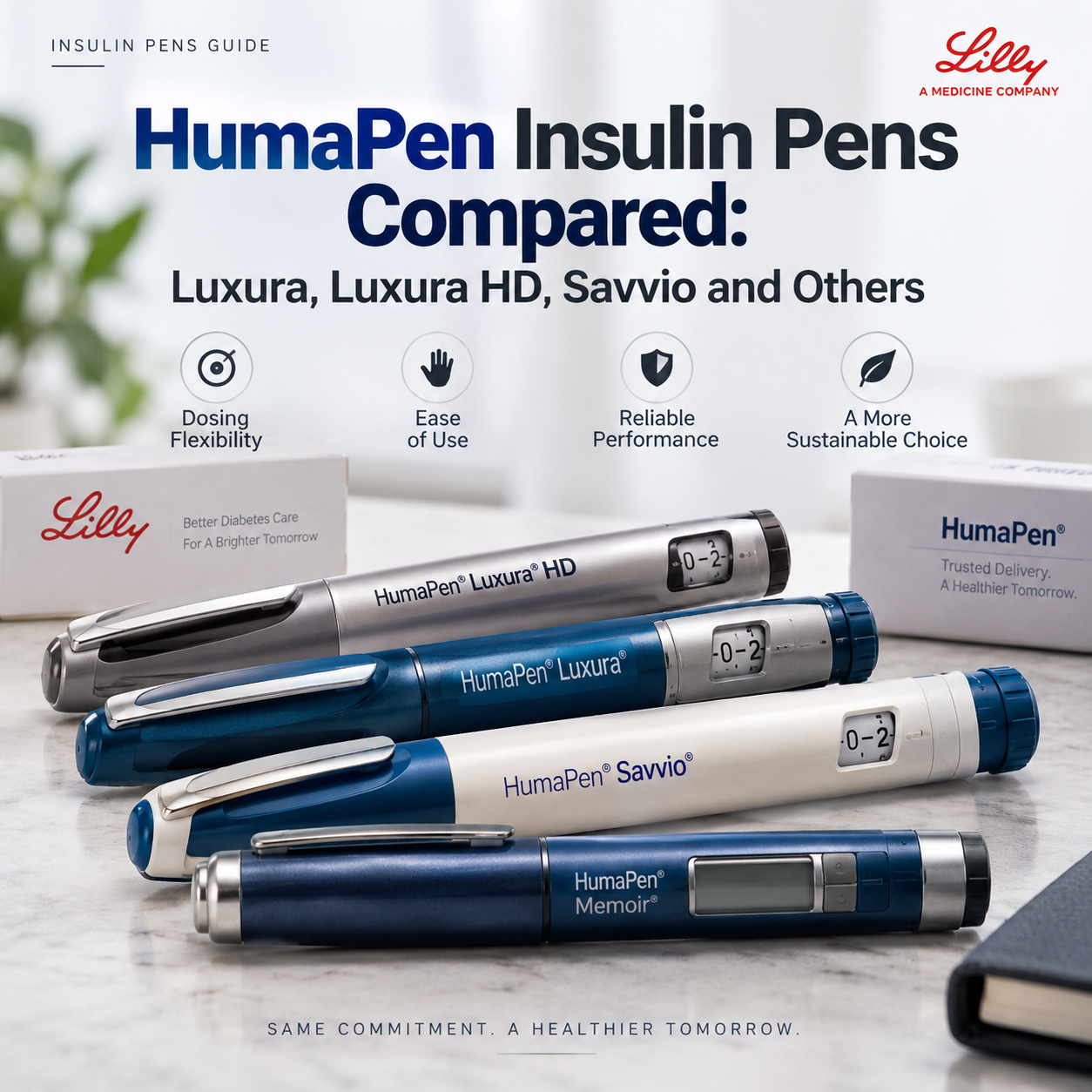
For people who use insulin every day, the insulin itself is only part of the equation. The device used to deliver it can make a noticeable difference in convenience, dosing flexibility, portability and the overall injection routine.
Over the years, Eli Lilly has introduced several reusable insulin pens under the HumaPen name. Some, such as HumaPen Luxura and HumaPen Memoir, represent earlier generations of reusable pen technology, while HumaPen Savvio represents a more recent mechanical design.
But what actually separates these pens? And is a newer insulin pen automatically a better one?
We took a closer look at manufacturer documentation, regulatory records and published research to compare the major HumaPen models and explain where each design has its strengths.
Why Reusable Insulin Pens Still Matter
Insulin delivery devices generally fall into two broad categories: prefilled disposable pens and reusable pens that accept replaceable insulin cartridges.
Prefilled pens offer obvious convenience. Once the insulin has been used, the entire pen is discarded.
Reusable pens work differently. The pen mechanism is retained while the insulin cartridge is replaced.
For some users, this provides several practical advantages:
- a durable pen body
- less device waste
- the ability to replace only the insulin cartridge
- a familiar injection mechanism that can be used over a long period
- in certain models, more specialized dose increments
The trade-off is that reusable pens require users to correctly install cartridges and ensure that the cartridge is compatible with the particular device.
This last point is important. An insulin cartridge should never be assumed to work simply because it physically fits a pen.
For example, Lilly's current instructions specify that HumaPen Savvio is intended for Lilly 3 mL insulin cartridges, and Lilly advises against using other manufacturers' cartridges in the device.
1. HumaPen Savvio: The Modern Mechanical HumaPen
Among the HumaPen family, HumaPen Savvio is probably the most relevant starting point today.
According to Lilly's instructions for use, Savvio is a reusable mechanical insulin pen designed for Lilly 3 mL insulin cartridges containing 100 units/mL insulin. It allows doses between 1 and 60 units, adjustable in 1-unit increments.
One particularly useful feature is two-way dose adjustment.
If a user accidentally dials too many units, the dose can simply be dialed backward without wasting insulin.
The pen also prevents the user from dialing a dose larger than the amount remaining in the cartridge.
Advantages of HumaPen Savvio
Simple mechanical operation
There are no batteries, electronic displays or charging requirements. For people who prefer a conventional mechanical device, this keeps the system relatively straightforward.
1–60 unit dosing range
The range covers many common insulin doses while retaining one-unit adjustment.
Dose correction without insulin loss
The dose selector can be moved backward if too much insulin is accidentally selected.
Reusable construction
Rather than discarding the entire pen when the insulin is finished, users replace the cartridge.
Long device design life
FDA documentation for Savvio lists a six-year use life for the device. The same regulatory comparison listed six years for its Luxura predecessor.
Limitations
Savvio uses 1-unit increments, meaning it does not provide the half-unit dosing capability found in HumaPen Luxura HD.
It is also specifically designed around compatible Lilly 3 mL cartridges. Availability of both the pen and compatible insulin cartridges varies considerably between countries.
Lilly additionally states that Savvio is not recommended for blind or visually impaired users unless assisted by a sighted person trained to operate the pen.
2. HumaPen Luxura: The Durable Predecessor
Before Savvio, HumaPen Luxura became one of Lilly's best-known reusable insulin pens.
Like Savvio, Luxura is a mechanical reusable pen accepting 3 mL cartridges and providing dosing in 1-unit increments up to 60 units.
Interestingly, FDA documentation comparing Savvio with Luxura shows that the basic dosing architecture remained remarkably similar:
| Feature | HumaPen Luxura | HumaPen Savvio |
|---|---|---|
| Reusable | Yes | Yes |
| Cartridge | 3 mL | 3 mL |
| Dose increment | 1 unit | 1 unit |
| Maximum dose | 60 units | 60 units |
| Two-way dose dialing | Yes | Yes |
| Mechanical design | Yes | Yes |
FDA documentation identifies Luxura as the predicate device used in the regulatory evaluation of Savvio.
One notable mechanical difference was cartridge installation. The regulatory comparison describes Luxura as using a threaded attachment requiring roughly 2½ turns, whereas Savvio introduced a quicker quarter-turn bayonet-style connection.
So Savvio was not a complete reinvention of HumaPen. It was, in many ways, a refinement of an already established platform.
Was HumaPen Luxura Accurate?
There is useful published evidence here.
A laboratory comparison of HumaPen Luxura, FlexPen, SoloSTAR and OptiClik tested 10-unit and 30-unit doses.
HumaPen Luxura showed mean absolute deviations of approximately 1.10% at 10 units and 0.62% at 30 units in that particular study. No Luxura 10-unit doses fell outside the tested ISO limits.
Another study compared the reusable Luxura, NovoPen 4 and ClikSTAR. All three demonstrated broadly comparable dose accuracy under the study conditions, with the authors concluding that the relatively small differences were unlikely to be clinically significant.
That is an important distinction.
It would be misleading to say that one pen is universally "more accurate" than every competing insulin pen based on a single laboratory comparison. Different studies used different devices, doses and experimental conditions.
What can reasonably be said is that HumaPen Luxura demonstrated strong dosing accuracy in published laboratory testing.
3. HumaPen Luxura HD: When Half a Unit Matters
This is where the HumaPen lineup becomes considerably more interesting.
HumaPen Luxura HD was designed for finer dosing than standard Luxura.
Instead of one-unit steps, Luxura HD allows dosing in 0.5-unit increments, with a dosing range of 1 to 30 units.
That seemingly small difference can matter considerably when small dose adjustments are required.
Published laboratory testing specifically evaluated the initial 0.5-unit dose of Luxura HD. Across the testing conditions, at least 95% of doses met the predefined accuracy criterion with 95% confidence, and all measured doses remained within the study's ±0.5-unit specification.
Luxura HD vs Standard Luxura
The trade-off is straightforward:
Luxura HD
0.5-unit adjustment
Maximum 30 units per injection
Designed around finer dosing
Standard Luxura
1-unit adjustment
Maximum 60 units per injection
Better suited to users who do not require half-unit adjustments
So "HD" is not simply a premium version of Luxura.
It solves a different dosing problem.
Interestingly, Lilly's current U.S. medicines information still provides official Luxura HD instructions for use alongside Humalog information.
4. HumaPen Memoir: An Early Attempt at a “Smart” Insulin Pen
Long before today's connected insulin pens became a major category, Lilly experimented with adding electronic memory to the traditional reusable pen.
That device was HumaPen Memoir.
Unlike the purely mechanical Luxura family, Memoir incorporated an electronic memory capable of recording previous injections.
Contemporary documentation described storage of the last 16 doses together with date and time information. The device offered doses up to 60 units in one-unit increments.
This addressed a very real everyday problem:
“Did I already take my insulin?”
For users administering several injections every day, remembering the exact time and amount of a previous dose can become surprisingly difficult.
Today, Bluetooth-connected pens and smart caps can provide much more sophisticated tracking. But historically, Memoir was an interesting bridge between a conventional mechanical pen and today's digital insulin-delivery ecosystem.
Its downside was complexity.
Electronics introduce additional components and make a device fundamentally different from a simple mechanical pen such as Savvio or Luxura.
For someone who simply wants a durable cartridge pen, electronic memory may provide little practical benefit.
5. HumaPen Ergo and Ergo II: Earlier Generations of the Same Idea
HumaPen Ergo and HumaPen Ergo II belong to an earlier generation of Lilly reusable pens.
Historical device comparisons list Ergo II as a reusable pen capable of delivering up to 60 units in one-unit increments, broadly resembling the dosing philosophy later seen in Luxura and Savvio.
These older HumaPen generations are useful for understanding how reusable pens evolved:
Ergo → Luxura → Savvio
The basic concept remained remarkably consistent:
a durable reusable body, replaceable Lilly insulin cartridges and mechanically selected doses.
What changed over time was ergonomics, cartridge handling, design and usability.
For buyers encountering older HumaPen models today, however, the important question is not simply whether the device was well designed when released.
The more important questions are current manufacturer support, cartridge compatibility, device condition and local availability.
HumaPen Savvio vs Luxura vs Luxura HD vs Memoir
Here is the practical comparison:
| Model | Type | Dose Increment | Maximum Dose | Distinguishing Feature |
|---|---|---|---|---|
| HumaPen Savvio | Reusable mechanical | 1 U | 60 U | Modern simplified reusable design |
| HumaPen Luxura | Reusable mechanical | 1 U | 60 U | Established durable HumaPen platform |
| HumaPen Luxura HD | Reusable mechanical | 0.5 U | 30 U | Fine half-unit dosing |
| HumaPen Memoir | Reusable electronic | 1 U | 60 U | Dose/time memory |
| HumaPen Ergo II | Reusable mechanical | 1 U | 60 U | Earlier-generation HumaPen |
Specifications and market status can vary by country and product generation. Historical HumaPen devices should therefore not automatically be assumed to have the same current compatibility or support as Savvio.
What About Prefilled Insulin Pens?
Reusable cartridge pens are only one side of the market.
Modern prefilled devices such as Lilly's KwikPen, Novo Nordisk's FlexPen/FlexTouch families and Sanofi's SoloStar platform take a different approach.
Instead of keeping the injector and replacing the cartridge, the insulin reservoir and delivery mechanism arrive together as a complete unit.
That creates a fundamentally different trade-off.
Prefilled Pens
Advantages
Very little setup
No cartridge installation
Convenient for travel and everyday use
Lower learning curve for many users
Disadvantages
Entire pen is discarded after use
More material waste
Users cannot simply retain the same pen body and insert another cartridge
Reusable Pens
Advantages
Durable device
Only the cartridge needs replacement
Potentially less device waste
Some specialized models offer features such as half-unit dosing
Disadvantages
Cartridge compatibility matters
Cartridges must be installed correctly
More components must be managed
Availability differs substantially between countries
A randomized handling study comparing a prefilled FlexPen with reusable HumaPen Luxura also found differences in intuitiveness and training requirements, illustrating that technical performance is not the only consideration when selecting an insulin delivery system.
Savvio or Luxura HD: Which Design Makes More Sense?
Rather than declaring one universally better, the meaningful distinction is what the device is designed to do.
For someone using standard whole-unit doses, Savvio provides a straightforward mechanical system with a large 1–60 unit dosing range.
For someone whose prescribed regimen requires half-unit adjustment, Luxura HD offers something Savvio does not: 0.5-unit increments.
For someone who values electronic dose history, the historical Memoir concept addressed another problem entirely.
That is why comparing insulin pens solely by appearance or price misses the point.
The important differences are:
dose increment → maximum dose → compatible cartridge → injection mechanism → usability → availability.
One Important Detail: Pen Color Does Not Identify the Insulin
HumaPen Savvio has been offered in different external colors, which makes the pens visually distinctive.
But Lilly explicitly warns that pen color is not intended to identify the insulin type. Users should check the cartridge label before every injection.
That matters particularly for people using more than one type of insulin.
A blue, red, silver or other colored pen should never substitute for checking what cartridge is actually installed.
Proper Priming Matters Too
Another detail sometimes overlooked when discussing insulin pens is priming.
Lilly instructs Savvio users to prime before every injection until insulin can be seen at the needle tip. The purpose is to confirm that the pen is ready to deliver the selected dose.
A new needle should also be used for each injection, and the pen should not be stored with the needle attached.
These seemingly small steps are part of correct pen operation—not optional extras.
The Bigger Picture: Insulin Pens Have Become Highly Specialized
Perhaps the most interesting thing about comparing HumaPen generations is how clearly insulin pens have evolved from simple injection tools into devices optimized around different needs.
Luxura emphasized durable reusable construction.
Luxura HD introduced fine half-unit adjustment.
Memoir experimented with digital dose memory.
Savvio refined the mechanical reusable concept with simpler cartridge handling and protection against dialing more insulin than remains in the cartridge. FDA documentation shows that both Savvio and its Luxura predecessor met the applicable ISO dose-delivery requirements evaluated during regulatory review.
Meanwhile, the wider insulin-pen market has moved simultaneously toward disposable convenience and increasingly sophisticated connected devices.
There is therefore no single insulin pen architecture that is ideal for everyone.
For some users, simplicity matters most.
For others, half-unit precision is essential.
Others prioritize portability, cartridge availability, dose memory or a familiar injection mechanism.
Final Thoughts
HumaPen is not a single insulin pen but a family of devices reflecting different stages in the evolution of insulin delivery.
HumaPen Savvio offers a relatively simple modern reusable system with 1-unit dosing up to 60 units.
HumaPen Luxura established much of the reusable mechanical platform that came before it.
HumaPen Luxura HD stands apart because of its 0.5-unit dosing capability.
And HumaPen Memoir remains an interesting early example of integrating injection history into an insulin pen.
Published studies also provide reassuring evidence that reusable HumaPen devices such as Luxura and Luxura HD were capable of accurate dose delivery under controlled testing conditions.
The most important lesson, however, is that an insulin pen should always be considered together with the specific insulin cartridge, prescribed dose and local product instructions. Similar-looking pens are not automatically interchangeable, and availability and approved compatibility can differ between countries.
For anyone comparing HumaPen models, those details matter considerably more than simply choosing the newest—or most expensive—pen.