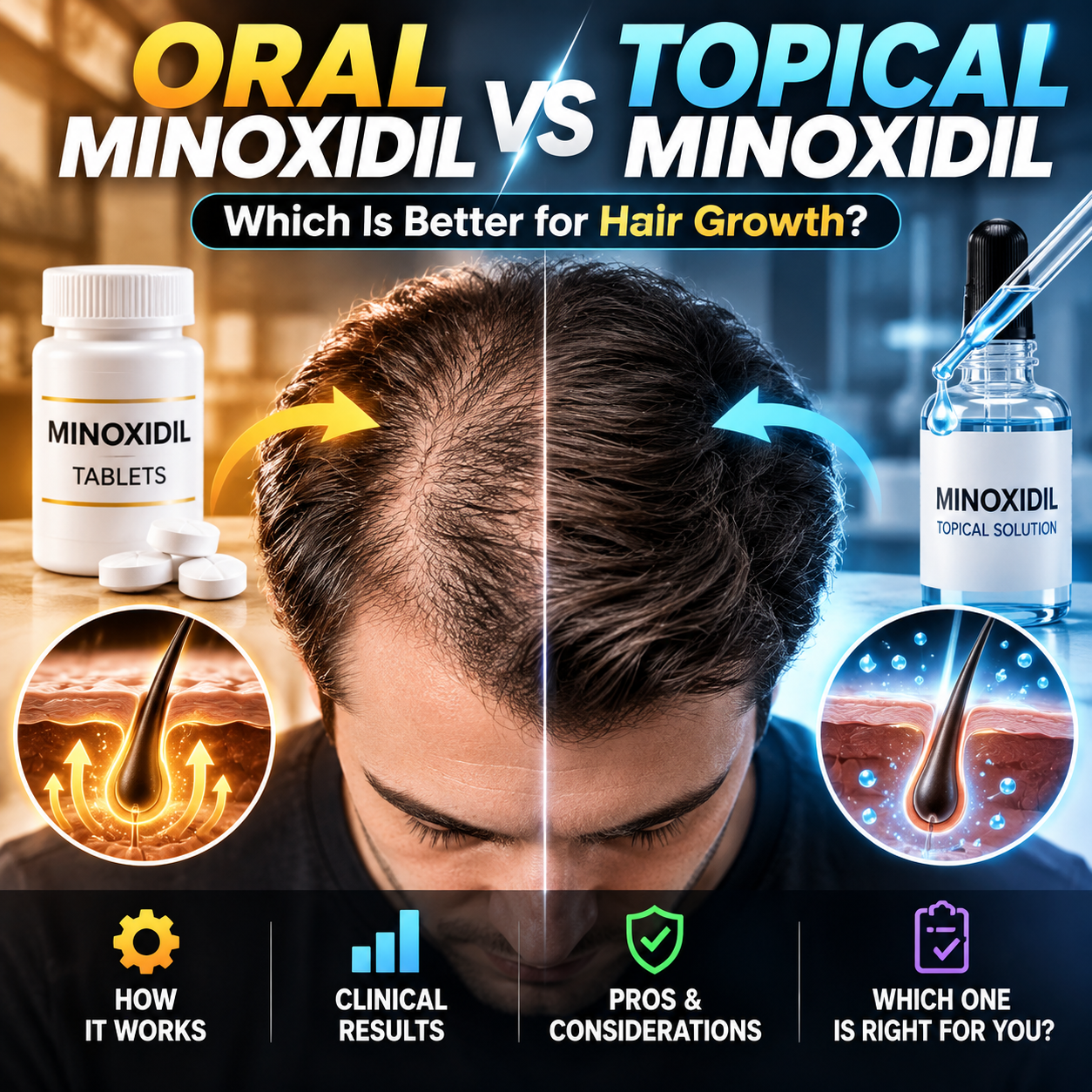
Minoxidil has been used to treat hair loss for decades. But today, people searching for minoxidil increasingly encounter two very different options: the familiar solution or foam applied directly to the scalp, and low-dose minoxidil taken as a tablet.
That raises an obvious question:
Is oral minoxidil actually better than topical minoxidil?
Recent clinical research gives us a much clearer picture.
The Same Drug, Two Very Different Ways to Use It
Topical minoxidil is applied directly to the scalp, typically as a solution or foam. It remains one of the most established pharmacological treatments for androgenetic alopecia, or pattern hair loss.
Oral minoxidil has a different history. Minoxidil tablets were originally developed as a medication for high blood pressure. In dermatology, however, physicians increasingly use much lower oral doses for hair loss.
This use of low-dose oral minoxidil for alopecia is off-label. In other words, oral minoxidil tablets are not FDA-approved specifically as a hair-loss treatment, even though their use for this purpose has attracted considerable clinical and research interest. PubMed
Does Oral Minoxidil Grow More Hair?
Not necessarily.
One randomized clinical trial published in JAMA Dermatology compared oral minoxidil 5 mg once daily with topical minoxidil 5% twice daily in men with androgenetic alopecia.
After 24 weeks, oral minoxidil was not demonstrated to be superior overall to topical 5% minoxidil in terminal hair density.
There was, however, an interesting difference in photographic assessment: oral minoxidil performed better in the vertex area, while a significant advantage was not demonstrated in the frontal scalp. PubMed
Another randomized trial compared low-dose oral minoxidil at 1 mg/day with topical 5% minoxidil over six months. Both groups experienced improvement, and researchers found no statistically significant overall difference between the treatments. PubMed
The practical conclusion is important:
Oral minoxidil should not simply be thought of as a “stronger version” of topical minoxidil.
Both can be effective.
Why Are People Interested in Oral Minoxidil?
Convenience is one of the biggest reasons.
Topical treatment requires repeated application to the scalp. Depending on the formulation and individual, users may also dislike the residue, styling inconvenience or scalp irritation associated with topical products.
A tablet eliminates the scalp-application step.
For someone who struggles to maintain a topical routine consistently, that difference can be significant. Hair-loss treatments generally depend heavily on long-term adherence, so a treatment that fits into a person's routine may sometimes be more useful than one that looks ideal on paper but is rarely used correctly.
Why Topical Minoxidil Still Makes Sense
Topical minoxidil has one major conceptual advantage: it delivers the medication directly to the area being treated while limiting systemic exposure compared with taking the drug orally.
It also has decades of use behind it and remains an established first-line pharmacological option for pattern hair loss. PubMed
For many users, especially those who tolerate topical formulations well, there may be little reason to switch simply because oral minoxidil has become more widely discussed.
Oral Minoxidil Requires a Different Level of Medical Consideration
This is where the two options differ most.
Once minoxidil is swallowed, the drug acts systemically rather than only at the scalp.
Minoxidil is a vasodilator, and oral tablets are prescription medicines originally indicated for hypertension. Therefore, low-dose oral minoxidil for hair loss should be considered with a clinician, particularly when cardiovascular conditions, blood-pressure issues or other medications are involved. NCTR CRS
The fact that a small dose is being used does not turn an oral prescription medication into the equivalent of a cosmetic supplement.
Oral or Topical: Which One Should You Choose?
There is no universal winner.
Topical minoxidil may make more sense if:
You want an established hair-loss treatment with less systemic exposure and do not mind applying a product to your scalp regularly.
Oral minoxidil may be considered if:
Topical treatment is difficult to maintain, poorly tolerated or otherwise unsuitable, and a clinician determines that oral treatment is appropriate.
The emerging research is particularly useful because it changes the question from:
“Which one is stronger?”
to:
“Which treatment can I use safely and consistently over the long term?”
For hair-loss treatment, that may be the more useful question.
This article is for general educational purposes and does not replace medical advice. Oral minoxidil used for hair loss is an off-label treatment and should be discussed with a qualified healthcare professional.