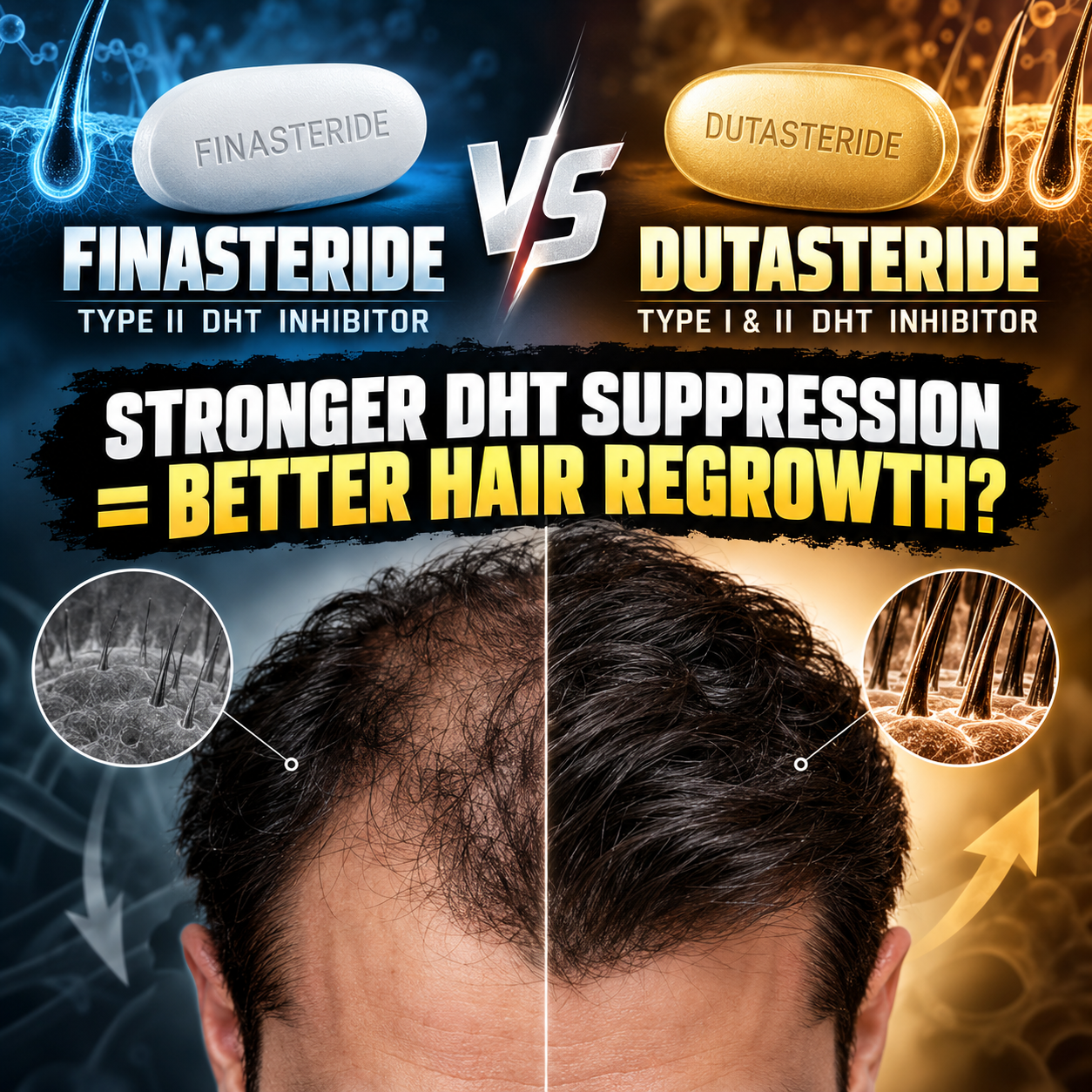
Two DHT-blocking treatments, one important question: does stronger hormone suppression lead to better hair regrowth?
For men experiencing androgenetic alopecia, commonly known as male pattern hair loss, finasteride and dutasteride are among the most widely studied oral treatments.
Both medications target dihydrotestosterone (DHT), a hormone that contributes to the gradual shrinking of genetically susceptible hair follicles. However, they differ in how extensively they inhibit DHT production.
So which treatment produces better results, and does the difference matter in everyday hair-loss management?
Why DHT Matters in Male Pattern Hair Loss
Male pattern hair loss is not simply caused by having too much testosterone.
In genetically susceptible individuals, DHT gradually causes certain scalp follicles to become smaller. This process, known as follicular miniaturization, produces progressively thinner, shorter hair.
Over time, the affected follicles may stop producing visible terminal hairs.
Finasteride and dutasteride work by inhibiting 5-alpha-reductase, the enzyme responsible for converting testosterone into DHT.
By reducing DHT activity, these medications can slow further miniaturization, preserve existing hair, and help some weakened follicles produce thicker hair again.
Finasteride: An Established Hair-Loss Treatment
Finasteride primarily inhibits type II 5-alpha-reductase.
The commonly studied oral dose for male pattern hair loss is 1 mg daily.
Its principal benefits include:
-
Slowing the progression of androgenetic alopecia.
-
Helping maintain existing scalp hair.
-
Increasing hair counts and improving visible coverage in some patients.
Finasteride has substantial clinical evidence supporting its effectiveness, particularly when treatment begins before extensive follicular miniaturization has occurred.
It is also approved by the US Food and Drug Administration (FDA) for male pattern hair loss.
Importantly, the goal of treatment is not always dramatic regrowth. Preventing continued deterioration can itself be a meaningful long-term result.
Dutasteride: A Broader Approach to DHT Suppression
Dutasteride inhibits both type I and type II 5-alpha-reductase.
This broader mechanism generally produces more extensive DHT suppression than finasteride.
The most frequently studied oral dose for androgenetic alopecia is 0.5 mg daily.
Dutasteride is approved for male pattern hair loss in countries including South Korea and Japan. In the United States, however, it is not FDA-approved for this indication.
Its stronger DHT suppression has raised an important clinical question: can it improve hair density beyond what finasteride achieves?
What Clinical Research Actually Shows
A 2022 network meta-analysis published in JAMA Dermatology compared treatments for male androgenetic alopecia across 23 trials.
At 24 weeks, oral dutasteride 0.5 mg daily demonstrated a greater increase in total hair density than oral finasteride 1 mg daily.
The estimated difference was approximately 7.1 additional hairs per square centimeter in favor of dutasteride.
A 2024 network meta-analysis also ranked dutasteride 0.5 mg daily highest for improvements in total and terminal hair density at six months.
A subsequent 2025 analysis similarly identified oral dutasteride 0.5 mg daily as the highest-ranked treatment among the compared monotherapies.
These findings suggest that dutasteride can offer a measurable advantage in hair density, although study quality, treatment duration, and individual response affect how confidently results can be generalized.
Does Better Hair Density Mean Better Visible Results?
Not necessarily in every patient.
Clinical studies measure outcomes such as hair count, hair thickness, and photographic improvement. These outcomes are related, but they are not identical.
An increase in hair density may improve scalp coverage, especially in thinning areas where follicles are still active.
However, the visible result also depends on:
-
The extent and duration of hair loss.
-
The number of follicles that remain capable of producing hair.
-
Hair thickness, color, and scalp contrast.
-
Individual responsiveness to DHT suppression.
This is why two people taking the same medication may experience noticeably different cosmetic outcomes.
How Long Does It Take to See Results?
Hair growth is gradual, and neither medication produces immediate changes.
Clinical studies commonly evaluate improvements after approximately 24 weeks, while longer-term treatment may be necessary to assess the full response.
Early benefits may appear as reduced progression rather than obvious regrowth.
Comparing standardized photographs over several months is generally more useful than judging changes from day to day.
Because androgenetic alopecia is progressive, benefits usually require continued treatment. Stopping therapy may allow the underlying hair-loss process to resume.
Is Dutasteride Always the Better Choice?
Although dutasteride often ranks higher for hair-density improvement in comparative studies, greater average efficacy does not automatically make it the best choice for everyone.
Finasteride remains an established treatment with extensive clinical experience and a specific FDA indication for male pattern hair loss.
Dutasteride may be considered where approved and clinically appropriate, particularly when stronger DHT suppression is desired.
There are also important differences in how long the medications remain in the body. Dutasteride has a substantially longer elimination half-life, which can affect treatment planning.
Both medicines require consideration of potential sexual adverse effects, reproductive concerns, contraindications, and individual medical history. Mood-related symptoms also warrant attention. These are prescription treatments, and they should not be started, combined, or switched without professional guidance.
What About Combining Treatment With Minoxidil?
Finasteride and dutasteride target the hormonal mechanism of androgenetic alopecia.
Minoxidil works through a different mechanism and can support hair growth without directly blocking DHT.
For some patients, clinicians may consider combining a DHT-targeting medication with topical minoxidil to address hair loss through complementary approaches.
The suitability of combination therapy depends on the individual's diagnosis, treatment response, and tolerability.
Using finasteride and dutasteride together, however, is not an established routine strategy for improving results.
Final Verdict: Which One Works Better?
Dutasteride generally demonstrates greater average improvements in hair density than finasteride in comparative clinical research.
Nevertheless, finasteride remains an effective, well-established option for slowing male pattern hair loss and maintaining existing hair.
The most appropriate treatment depends on more than the strongest average study result. Regulatory approval, medical history, tolerability, treatment goals, and long-term management all matter.
Ultimately, successful hair-loss treatment is not only about growing new hair. It is also about preserving the hair that remains before further miniaturization occurs.
Medical note: This article is intended for educational purposes and does not replace professional medical advice. Both medications are prescription drugs. Neither should be used during pregnancy; pregnant individuals should avoid handling crushed or broken tablets or leaking capsules. Availability and approved indications vary by country.