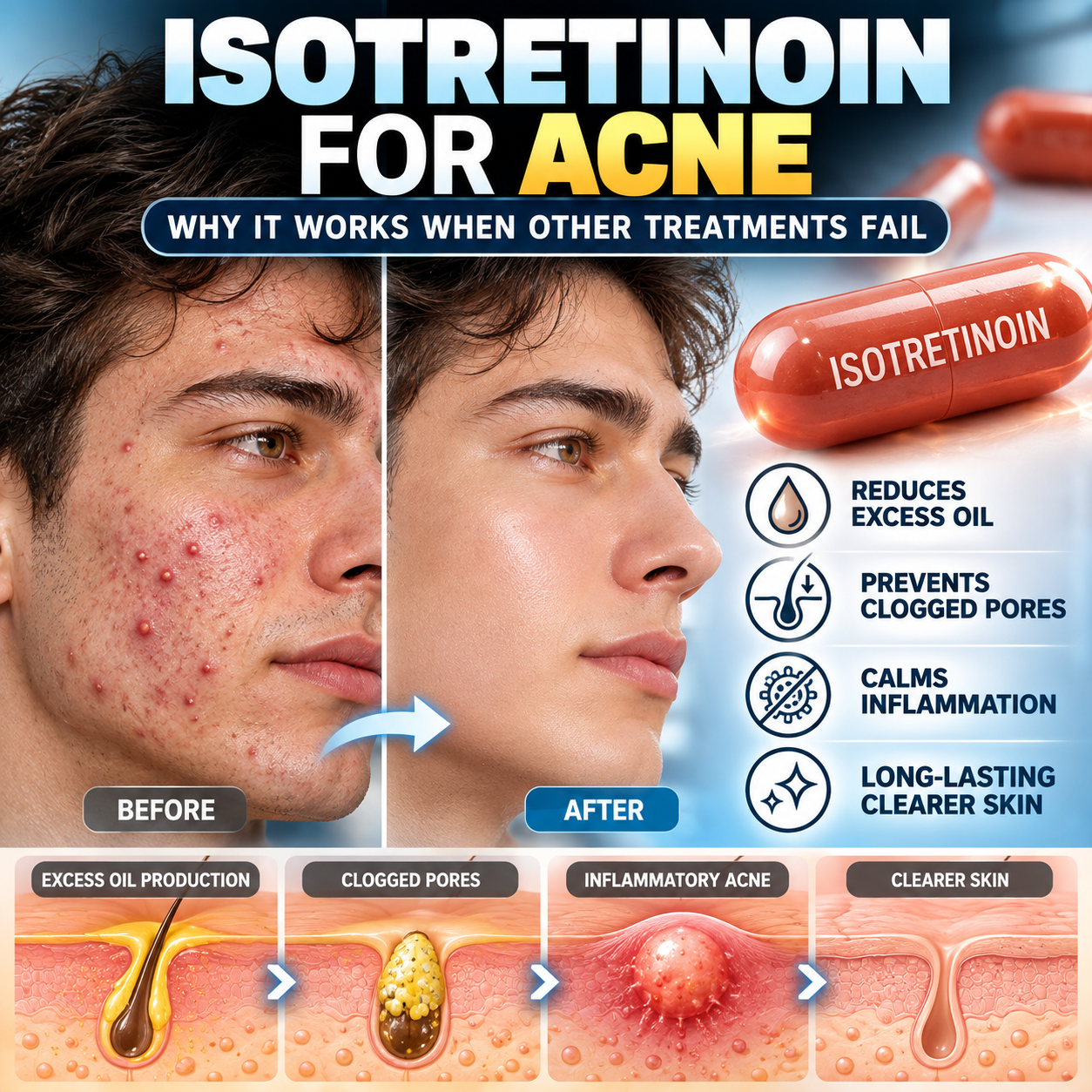
For persistent, severe, or treatment-resistant acne, isotretinoin offers something many conventional treatments cannot: the possibility of long-lasting improvement after a defined course of treatment.
Acne is more than an occasional breakout. For some people, it becomes a persistent cycle of clogged pores, excess oil, inflammation, and painful lesions that return despite months of skincare and medication.
Topical retinoids, benzoyl peroxide, and oral antibiotics can help many patients. But when acne remains severe, causes scarring, or repeatedly returns, dermatologists may consider a different approach.
That is where oral isotretinoin comes in.
Rather than targeting only one aspect of acne, isotretinoin acts on several of the biological processes responsible for breakouts.
What Makes Isotretinoin Different?
Isotretinoin is an oral retinoid derived from vitamin A.
Its most important action is a substantial reduction in sebum production.
Sebum is the natural oil produced by sebaceous glands. Although it helps protect the skin, excessive sebum can contribute to blocked follicles and an environment that supports acne development.
Isotretinoin reduces the activity and size of sebaceous glands, often producing a significant and sustained reduction in oiliness during treatment.
It also helps normalize follicular keratinization, reducing the tendency of dead skin cells to accumulate and block pores.
As sebum production decreases, the environment becomes less favorable for the proliferation of Cutibacterium acnes, a bacterium associated with inflammatory acne.
Isotretinoin also reduces acne-related inflammation.
These combined actions explain why it can be particularly effective against severe inflammatory acne.
Four Major Benefits of Isotretinoin
1. Significantly Reduces Excess Oil
For patients with very oily skin, isotretinoin can dramatically reduce sebum production.
This matters because excess oil is one of the major factors contributing to recurring breakouts.
Unlike products that temporarily remove surface oil, isotretinoin changes sebaceous gland activity during treatment.
2. Helps Clear Deep, Inflammatory Acne
Painful nodules and cyst-like inflammatory lesions can be especially difficult to manage with topical treatments alone.
By addressing several underlying acne mechanisms simultaneously, isotretinoin can substantially reduce severe inflammatory lesions.
3. May Reduce the Risk of New Acne Scars
Deep inflammatory acne can permanently damage the skin.
Controlling active acne helps reduce the formation of new lesions that could otherwise leave scars.
However, isotretinoin does not automatically remove existing pitted or raised scars. Those may require separate dermatological treatments.
4. Can Produce Long-Lasting Clearance
One of isotretinoin's most distinctive advantages is that improvement may continue after the treatment course ends.
Some patients experience prolonged remission after a single course, while others eventually relapse and require further treatment.
It is therefore more accurate to describe isotretinoin as a treatment capable of long-lasting clearance rather than a guaranteed permanent cure.
Who Might Benefit Most?
The 2024 American Academy of Dermatology acne guidelines strongly recommend oral isotretinoin for acne that is severe, causes scarring or significant psychosocial burden, or has not responded adequately to standard treatments.
This means treatment decisions are not based solely on the number of visible pimples.
A patient with recurring inflammatory acne that leaves scars may be an appropriate candidate even if the condition is not constantly at its most severe.
A dermatologist considers the type of acne, previous treatments, scarring risk, medical history, and the patient's goals before recommending therapy.
How Long Does Isotretinoin Take to Work?
Isotretinoin works gradually.
A typical treatment course often lasts approximately four to six months, although the duration varies according to the prescribed regimen, response, and tolerability.
Some patients notice less oily skin relatively early.
Visible improvement in inflammatory lesions generally develops over weeks to months, and acne may temporarily worsen near the beginning of treatment.
The final outcome should not be judged after only a few weeks.
Regular follow-up allows the dermatologist to evaluate progress and adjust treatment when appropriate.
Will Acne Return After Treatment?
This is one of the most common questions patients ask.
Isotretinoin can provide long-lasting clearance, but recurrence is possible.
The likelihood of relapse varies according to factors such as acne severity, age, hormonal influences, treatment regimen, and individual susceptibility.
Some people remain clear for years, while others experience milder breakouts or require another medically supervised course.
Long-term skincare or maintenance treatment may also be recommended after isotretinoin.
The key advantage is that a finite treatment course can sometimes produce benefits that continue well beyond the final dose.
Isotretinoin Better Than Antibiotics?
The two treatments work differently.
Oral antibiotics such as doxycycline mainly help reduce acne-associated inflammation and bacterial activity.
They can be useful for inflammatory acne, usually alongside appropriate topical therapy.
However, prolonged antibiotic use is generally discouraged because of antimicrobial resistance and other considerations.
Isotretinoin acts more broadly, particularly by substantially suppressing sebum production and helping prevent clogged follicles.
For severe or treatment-resistant acne, this broader mechanism can make isotretinoin a more suitable option.
That does not mean every patient with acne needs isotretinoin. Many cases respond well to simpler treatments.
Practical Skincare During Treatment
Because isotretinoin reduces oil production, dryness is extremely common.
A simple, gentle skincare routine can make treatment more manageable.
-
Use a mild, non-abrasive cleanser.
-
Apply a fragrance-free moisturizer regularly.
-
Keep a moisturizing lip balm available.
-
Use broad-spectrum sunscreen with SPF 30 or higher.
-
Avoid harsh exfoliants and unnecessary irritating products.
-
Discuss new acne medications or supplements with your dermatologist.
Patients should also follow the specific administration instructions for their prescribed isotretinoin formulation, as food-related directions can differ between products.
Important Safety Considerations
Isotretinoin is a prescription medication that requires medical supervision.
It must never be used during pregnancy because it can cause severe birth defects. Patients who can become pregnant must follow the applicable pregnancy-prevention and testing requirements.
In the United States, isotretinoin is dispensed under the FDA's iPLEDGE REMS safety program.
Dermatologists also assess liver function and blood lipids as appropriate. Dry skin and lips are common, while other possible adverse effects require individual evaluation.
Patients should report significant mood changes, severe headaches, visual disturbances, or other concerning symptoms promptly.
Isotretinoin should not be combined with vitamin A supplements or tetracycline-class antibiotics unless specifically directed by a clinician.
Treatment decisions, dosage, and monitoring must always be managed by a qualified healthcare professional.
Final Verdict: Why Isotretinoin Remains Important
Isotretinoin remains one of the most effective available treatments for severe and treatment-resistant acne because it addresses multiple underlying causes of breakouts.
Its benefits go beyond reducing the number of visible pimples.
By substantially reducing excess oil, improving inflammatory acne, and limiting the development of new lesions, it can help protect the skin from further acne-related damage.
Most importantly, some patients achieve long-lasting clearance after completing a treatment course.
The real advantage of isotretinoin is not simply clearer skin during treatment. It is the possibility of keeping acne under control long after treatment has ended.
Medical disclaimer: This article is for educational purposes only and does not replace professional medical advice. Isotretinoin is a prescription medication with important safety requirements, particularly regarding pregnancy prevention. Treatment must be supervised by a qualified healthcare professional.