Pancreatic cancer is widely recognized as an aggressive disease with poor outcomes, especially when diagnosed at advanced stages.
Gemcitabine (gemcitabine) remains one of the established chemotherapy options used in pancreatic cancer, but treatment responses are often limited—one reason combination strategies continue to be explored.
A 2022 preclinical study investigated whether adding ivermectin—a drug best known for antiparasitic use—could enhance gemcitabine’s anti-tumor activity in pancreatic cancer models. The paper is:
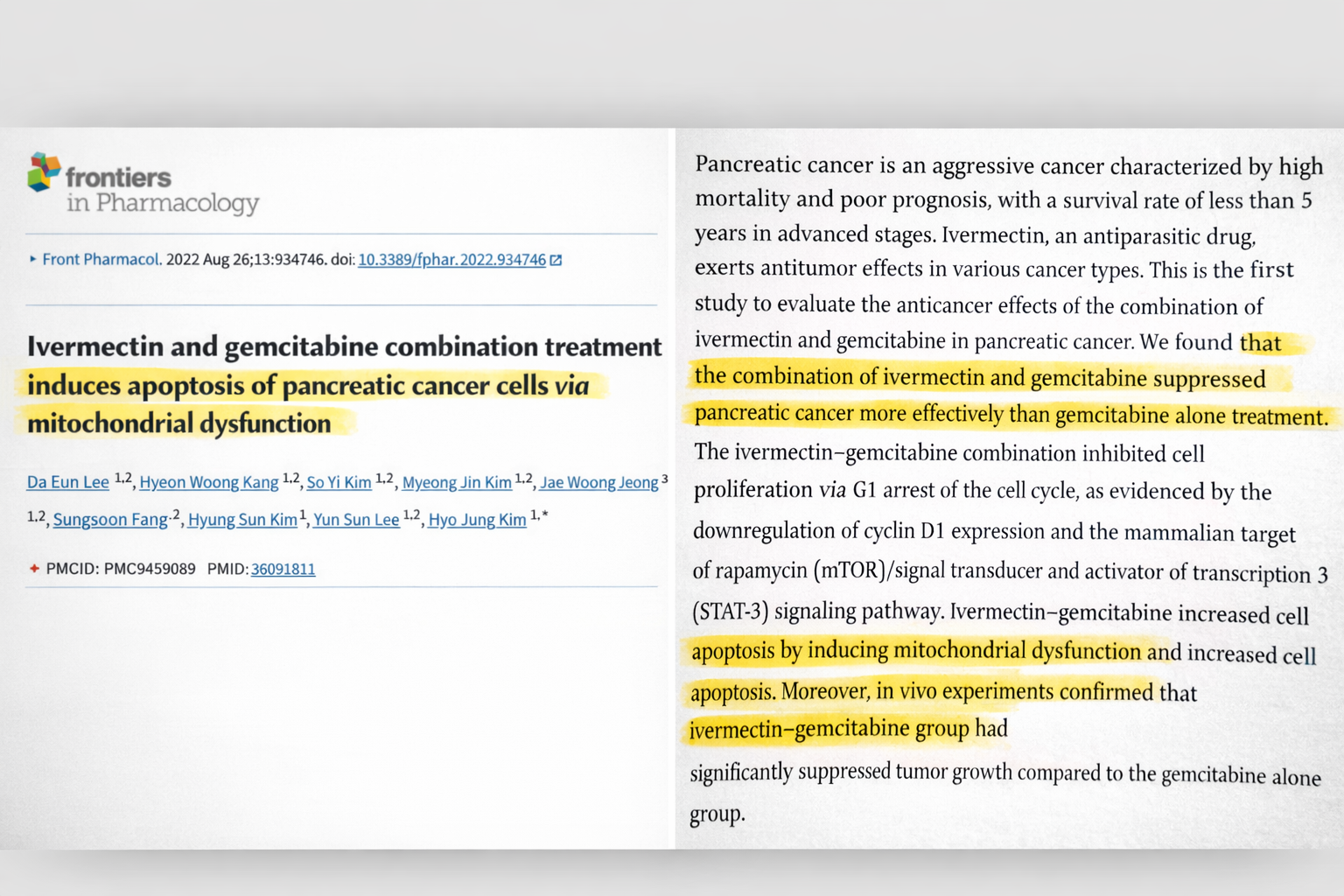
“Ivermectin and gemcitabine combination treatment induces apoptosis of pancreatic cancer cells via mitochondrial dysfunction”
Frontiers in Pharmacology (2022) — PMCID: PMC9459089 — PMID: 36091811
This post summarizes what the authors tested, what they observed, and what the findings do (and do not) mean—sticking closely to the reported data.
Where was the study conducted?
According to the paper’s ethics statement:
-
Human-related procedures (patient-derived materials) were reviewed by the ethics committee of Gangnam Severance Hospital, and written informed consent was obtained from all participants.
-
Animal experiments were reviewed and approved under protocols associated with Gangnam Severance Hospital of Yonsei University.
In other words, both patient-related procedures and animal experiments were conducted under institutional ethics oversight.
Study type: Preclinical (not a clinical trial)
This work is not a human clinical trial. It is a preclinical study combining:
-
Cell-line experiments (in vitro)
-
Patient-derived organoids (ex vivo / organoid model)
-
Mouse tumor models (in vivo)
The core question: does ivermectin + gemcitabine show stronger anti-cancer effects than gemcitabine alone—and if so, what cellular signals might explain the difference?
What models and methods were used?
1) Human pancreatic cancer cell lines
The authors used two widely studied human pancreatic cancer cell lines:
-
MIA PaCa-2
-
PANC-1
They assessed:
-
Cell viability and proliferation (WST-1)
-
Cell-cycle distribution (flow cytometry)
-
Apoptosis (Annexin V/PI staining, caspase-related signals)
-
Oxidative stress (ROS measurement)
-
Mitochondrial function readouts (mitochondrial membrane potential; oxygen consumption rate)
-
Pathway signaling changes (including mTOR/STAT3-related signals)
2) Patient-derived organoids
Pancreatic tissues were obtained from patients diagnosed at Gangnam Severance Hospital (2018–2019) and used to generate organoids. The study reports that ivermectin inhibited organoid growth in a concentration-dependent manner.
3) Mouse xenograft model
A tumor xenograft model was created by injecting PANC-1 cells into nude mice. Mice were randomized into treatment groups including gemcitabine alone versus the combination, and tumor growth was tracked over time.
Key findings: What the study reported
1) Stronger growth suppression vs. gemcitabine alone
Across cell viability experiments, the combination of ivermectin + gemcitabine reduced cell viability more than gemcitabine alone in both PANC-1 and MIA PaCa-2 cells. The authors describe this as a synergistic enhancement of gemcitabine’s anti-proliferative effect.
2) Cell-cycle effects: Increased G1 arrest signals
The study reports that combination treatment increased markers consistent with G1 phase arrest more than gemcitabine alone, including:
-
Reduced cyclin D1 expression (downregulation)
-
Changes in related cell-cycle regulators consistent with slowing G1-to-S progression
In practical terms: the combination appeared to push more cells into a “growth brake” state compared with gemcitabine alone, based on their assays.
3) Signaling changes: mTOR/STAT3 axis downshift
The authors report inhibitory signals along pathways involving:
-
mTOR
-
STAT3
These pathways are frequently discussed in cancer biology because they are involved in growth and survival signaling. The paper’s conclusion is that ivermectin + gemcitabine more strongly downregulated these signaling routes than gemcitabine alone in their experimental setting.
4) More apoptosis, linked to mitochondrial dysfunction
A central claim of the paper is that the combination increases apoptosis through mitochondrial disruption. The reported chain of observations includes:
-
Increased reactive oxygen species (ROS)
-
Reduced mitochondrial membrane potential (MMP)
-
Reduced oxygen consumption rate (OCR), suggesting impaired mitochondrial respiration
-
Increased pro-apoptotic signaling (including caspase-related changes)
In simple terms: compared with gemcitabine alone, the combination produced stronger “cell stress + mitochondrial shutdown” signals and was associated with increased programmed cell death markers.
5) Mitophagy-related signals: Inhibition signals reported
The authors also report that the combination inhibited signals consistent with reduced mitophagy. Mitophagy is the process cells use to remove damaged mitochondria; in cancer cells, this can sometimes function as a survival mechanism under stress. The study argues that disrupting this “mitochondrial cleanup” process could contribute to increased cell death under combination treatment.
6) In vivo (mouse) data: Tumor growth suppression was stronger in the combo group
In the xenograft mouse model, the study reports that:
-
Tumor growth was significantly more suppressed in the ivermectin + gemcitabine group compared with the gemcitabine-alone group.
-
The paper also reports no significant difference in body weight across groups during the experiment (a general tolerability observation in that specific model and timeframe, not a clinical safety conclusion).
What this study does not prove (important boundaries)
Even though the signals were consistent across multiple experimental layers, this is still preclinical evidence. The study does not establish:
-
Clinical efficacy in human patients
-
Optimal dosing or scheduling in humans
-
Safety profile of this combination in cancer patients
-
Whether the same magnitude of benefit would appear in modern standard-of-care regimens
A preclinical “synergy signal” is a reason to investigate further—not a definitive proof of clinical benefit.
Why this paper drew attention: A clear “repurposing + mechanism” narrative
From a research perspective, the paper is notable because it doesn’t stop at “the combination reduced tumor growth.” It attempts to connect:
-
Growth inhibition (viability + cell-cycle changes)
→ with -
Survival pathway shifts (mTOR/STAT3)
→ with -
Mitochondria-centered stress biology (ROS, MMP, OCR)
→ plus -
Mitophagy-related survival signaling
This “mechanistic consistency” is what often makes repurposing studies more compelling at the hypothesis-building stage.
Bottom line
This 2022 study reports that combining ivermectin with gemcitabine suppressed pancreatic cancer models more effectively than gemcitabine alone, with mechanistic signals pointing toward mitochondrial dysfunction, increased oxidative stress, reduced energy production, and increased apoptosis—along with stronger tumor suppression in a mouse xenograft model.
It remains early-stage evidence, but it’s a clear example of how drug repurposing research can generate testable hypotheses for future work.