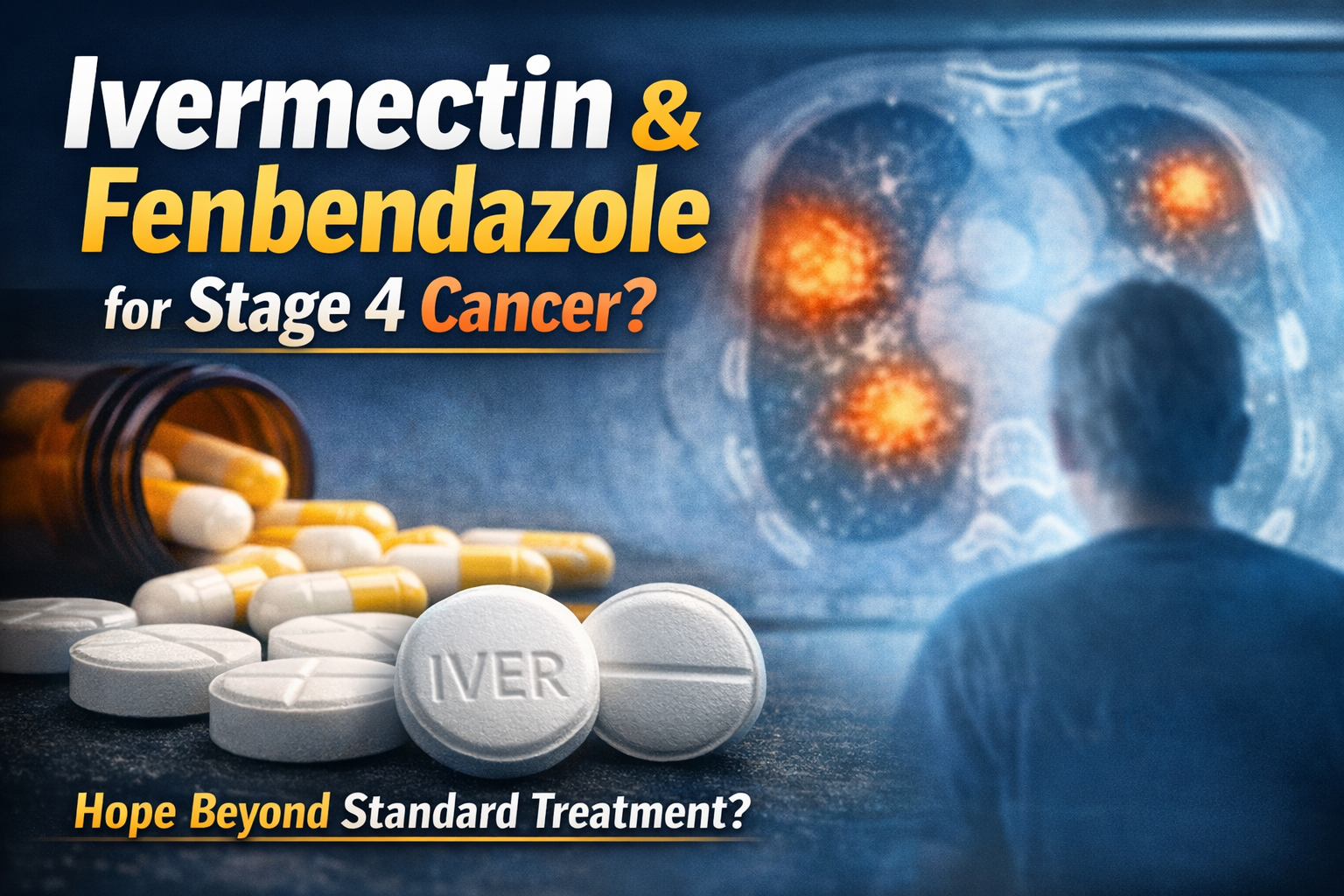
Stage 4 cancer is often the moment when everything changes at once.
For patients and families, it is no longer just about hearing a diagnosis. It becomes a collision of fear, time pressure, treatment decisions, financial stress, and the desperate need to find anything that might still help.
In online cancer communities, that desperation often leads people toward alternative or repurposed compounds such as ivermectin and fenbendazole.
These discussions are rarely calm or purely scientific. They are emotional, urgent, and deeply personal. Some people share dramatic recovery stories. Others question whether those stories are believable. Many are simply trying to make sense of what to do when standard treatment feels limited, delayed, or too harsh to endure.
This article looks at how patients and caregivers are actually talking about ivermectin and fenbendazole in stage 4 cancer discussions, and what those conversations reveal about the reality many people are facing.
────────────────────────────────────────
Why Stage 4 Cancer Patients Start Looking for Alternatives
One pattern shows up again and again in these discussions.
People usually do not begin with alternative approaches because they reject medicine from the start. More often, they arrive there after feeling trapped.
Some are told the cancer is already advanced or has spread to multiple organs. Some are waiting for surgery, scans, chemotherapy, or specialist appointments. Some fear that aggressive treatment may damage what little strength they have left. Others simply feel they have run out of conventional options.
When patients feel cornered, they start looking for anything that offers even a small sense of control.
That is where ivermectin and fenbendazole repeatedly enter the conversation.
────────────────────────────────────────
The Kind of Story That Drives Interest
In the forum discussion, the main story that triggered reactions was a highly dramatic personal account.
A parent claimed that a 24-year-old daughter had been diagnosed with stage 4 lymphoma that had spread to the brain, spleen, lungs, liver, and other organs. According to the post, while treatment was delayed for months, she began taking fenbendazole and ivermectin daily. The parent then stated that after several weeks of chemotherapy, scans showed no trace of cancer, and they strongly believed the repurposed-drug protocol played a major role.
Whether readers accepted the story or not, this is exactly the kind of testimony that spreads rapidly in cancer spaces online.
Why?
Because it combines everything desperate families want to hear:
a young patient
a severe diagnosis
treatment delays
a simple alternative protocol
a dramatic turnaround
and a return to normal life
That format is emotionally powerful. It gives people something they feel standard oncology often does not give them enough of: hope.
────────────────────────────────────────
Why These Stories Spread So Fast
Anecdotal cancer stories spread quickly because they do more than share information. They create possibility.
In serious illness communities, people are not only asking, “Is this proven?”
They are also asking:
What do I do while waiting?
What if standard treatment is too late?
What if chemo fails?
What if the doctors are missing something?
What if there is something inexpensive that could still help?
This is why stories about ivermectin and fenbendazole gain traction even when evidence remains disputed or incomplete in public discussion. They are being shared not just as medical claims, but as emotional lifelines.
In that sense, the popularity of these protocols says as much about the psychological state of patients as it does about the compounds themselves.
────────────────────────────────────────
The Forum Reactions Were Deeply Divided
The replies did not move in one direction. They split into several clear camps.
One group responded with enthusiasm. These posters said they hoped more people would discover the protocol. Some claimed they or someone they knew had also used fenbendazole, ivermectin, or related compounds and seen major improvement. Others referenced well-known online protocol stories and said they believed these compounds were helping real patients.
A second group responded with skepticism. Some questioned whether a patient with advanced disease would really wait that long for chemotherapy. Others questioned whether the diagnosis, timeline, or interpretation of the scan results made sense. A few even suggested that misdiagnosis or exaggeration could not be ruled out.
A third group was not debating the science at all. They were focused on access. They asked where to buy the medications, how people were sourcing them, whether they had to be stage 4 to try them, and whether there were side effects.
A fourth group showed something even more revealing: distrust. Their comments reflected deep anger toward mainstream medicine, pharmaceutical companies, or the healthcare system as a whole. In their view, affordable alternatives were being ignored, suppressed, or dismissed too quickly.
And finally, there were also fringe replies that moved into conspiracy territory, which is common in loosely moderated health forums. Those comments usually reduce the quality of the discussion but also show how quickly vulnerable patients can be pulled into increasingly extreme narratives when they are searching for answers.
────────────────────────────────────────
What These Conversations Really Reveal
The most important insight is not simply that people are talking about ivermectin and fenbendazole.
It is why they are talking about them.
Across posts and replies, the same themes keep surfacing:
fear of losing time
fear of treatment side effects
frustration with delays in care
hope for a less toxic option
desire to actively do something
and deep mistrust of institutions that seem slow, dismissive, or financially driven
For many cancer patients, alternative protocols become attractive not only because of what they might do biologically, but because of what they do psychologically.
They restore a sense of action.
Instead of waiting helplessly, patients feel they are doing something immediately. That matters more than many outsiders realize.
────────────────────────────────────────
Why Ivermectin and Fenbendazole Keep Appearing Together
In many online discussions, these two drugs are mentioned as part of the same informal cancer protocol.
Fenbendazole is best known as an antiparasitic product originally used in animals, while ivermectin is a long-used antiparasitic drug with a much broader public profile. In alternative cancer spaces, both are often discussed as repurposed compounds that may interfere with cancer-related pathways, cell survival, inflammation, metabolism, or tumor growth.
Patients are drawn to them for several reasons:
they are familiar names
they are often seen as relatively accessible
they are viewed by supporters as lower-cost alternatives
and they are surrounded by dramatic testimonial content online
In practice, this makes them ideal candidates for viral word-of-mouth spread, regardless of whether individual claims are verified.
────────────────────────────────────────
The Real Driver Is Not Just Belief. It Is Treatment Friction.
A major detail in the forum thread was the claim of a long delay before chemotherapy began.
Whether or not every timeline in these stories is accurate, the reason this detail resonates is simple: many people have experienced some kind of treatment friction.
That might mean waiting for appointments, insurance approvals, specialist referrals, repeat scans, biopsy confirmation, surgery scheduling, or second opinions.
When cancer is advancing, even short delays can feel unbearable. Patients and families often interpret that waiting period as a dangerous gap they need to fill themselves.
That is exactly when self-directed protocols start to look attractive.
So even when people argue about whether a specific story is fully credible, the emotional logic behind it still feels believable to readers because treatment delays are something many have genuinely experienced.
────────────────────────────────────────
Not Everyone in These Discussions Is Looking for a Miracle
One mistake outsiders often make is assuming everyone interested in these protocols is chasing fantasy.
That is not always what is happening.
Some patients are not rejecting chemotherapy or surgery. They are looking for something to use alongside conventional care.
Some are trying to bridge time while waiting.
Some are dealing with relapse, metastasis, or poor prognosis and feel the usual path no longer offers enough.
Some are less focused on “curing cancer” and more focused on extending time, preserving strength, reducing suffering, or improving scan results if possible.
That distinction matters.
For many people, ivermectin and fenbendazole are being discussed not as replacements in a simple all-or-nothing sense, but as part of a broader search for added leverage in a situation that already feels unwinnable.
────────────────────────────────────────
What Caregivers Are Really Looking For
Caregivers showed up strongly in the tone of this discussion.
And their mindset is often different from the patient’s.
Patients may be exhausted, frightened, or overwhelmed. Caregivers, meanwhile, often become researchers, organizers, schedulers, buyers, and advocates. They read forums late at night, compare stories, collect protocols, search for suppliers, and try to find patterns in what helped other families.
That is why these discussions matter so much.
Even when the information is messy, what caregivers are really searching for is not just a drug. They are searching for something they can still do for the person they love.
That makes anecdotal success stories especially powerful, because they offer not only hope, but a task, a direction, and a reason to keep pushing.
────────────────────────────────────────
The Risk of Online Cancer Narratives
At the same time, these communities can easily become distorted.
When dramatic recovery stories spread faster than careful analysis, people may overestimate how often certain outcomes happen. When users confidently share sourcing tips, dosage claims, or absolute statements about “miracle cures,” vulnerable readers may interpret anecdote as certainty.
Forums also compress very different situations into the same thread:
different cancer types
different stages
different timelines
different combinations with chemo, surgery, or radiation
different scan interpretations
different baseline health conditions
That means two people may talk about “the same protocol” while actually describing very different realities.
This is why these stories are emotionally compelling but also difficult to interpret cleanly.
────────────────────────────────────────
Why the Topic Is Not Going Away
The discussion around ivermectin and fenbendazole for stage 4 cancer is not fading because it touches too many unresolved pressures at once.
It sits at the intersection of:
serious illness
medical uncertainty
treatment toxicity
internet-driven testimony
low-cost repurposed drug interest
and widespread distrust of institutional healthcare
As long as patients continue to feel that they are running out of time, and as long as stories of unexpected recovery continue to circulate, people will keep returning to these compounds.
The conversation is not sustained only by chemistry.
It is sustained by human desperation, curiosity, and the refusal to stop looking.
────────────────────────────────────────
The Bottom Line
What the forum really shows is not a neat scientific conclusion.
It shows the emotional landscape of stage 4 cancer.
Some people see ivermectin and fenbendazole as promising repurposed tools.
Some see them as overhyped anecdotes.
Some see them as a last chance.
Some see them as a supplement to mainstream care.
And some simply see them as one more path worth exploring when everything else feels uncertain.
That is why these discussions keep spreading.
Not because every story is proven.
But because people facing advanced cancer are rarely looking for abstract debate.
They are looking for time.
They are looking for possibility.
And they are looking for something that makes the situation feel less helpless.
In that environment, even one story of recovery can travel very far.