The scale is finally moving.
Your waist is getting smaller.
Your old jeans fit again.
People are starting to notice.
Everything seems to be going exactly according to plan.
Then one day you walk into the gym, pick up a weight that used to feel normal and think:
Wait. Why does this suddenly feel so heavy?
This is becoming a surprisingly important question in the GLP 1 era.
Semaglutide and tirzepatide have completely changed the conversation around weight loss. For many people, losing a significant amount of body weight is now more achievable than it used to be.
But there is one small problem with your bathroom scale.
It has absolutely no idea what you lost.
Lose 10kg and the scale celebrates.
It does not tell you whether that 10kg came from fat, water, lean tissue or some combination of all three.
And if your goal is not simply to become lighter, but to become leaner, healthier and still physically strong, that difference matters.
A lot.
Losing Weight and Losing Fat Are Not the Same Thing
This sounds obvious once somebody says it.
But most of us still treat the number on the scale as the final score.
90kg becomes 85kg.
85kg becomes 80kg.
Great.
Except your body is not one giant block of tissue.
When body weight decreases substantially, some of that weight usually comes from fat and some can come from lean mass.
And this is not something unique to GLP 1 medications.
It also happens during ordinary dieting.
A major 2026 meta analysis examined 20 randomized controlled trials involving 15,782 participants. It found that lean mass represented a meaningful proportion of the total weight lost with semaglutide, tirzepatide and liraglutide.
Interestingly, the overall proportion was broadly comparable with intensive lifestyle based weight loss.
So the internet headline:
“GLP 1 drugs destroy your muscles!”
is much too simple.
But the opposite headline:
“Do not worry about muscle at all!”
is not particularly smart either.
The real answer lives somewhere in between.
What Happens With Tirzepatide?
This is where the numbers get interesting.
A body composition analysis from the SURMOUNT 1 trial looked at people with overweight or obesity who received tirzepatide.
After 72 weeks, body weight in the tirzepatide group had fallen by about 21.3 percent.
That is a lot of weight.
But researchers did not stop at the bathroom scale.
They used DXA scans to look at body composition.
The result?
Approximately 74 percent of the weight lost was fat mass and 26 percent was lean mass.
Fat mass fell by about 15.9kg on average, while lean mass fell by about 5.6kg.
At first glance, 5.6kg sounds scary.
But there is an important detail.
Lean mass does not mean pure skeletal muscle.
Lean mass includes water and other non fat tissues in addition to muscle.
So you cannot look at 5.6kg of lost lean mass and simply say:
“I lost 5.6kg of muscle.”
That would be incorrect.
Still, the study tells us something worth paying attention to.
When a person loses a very large amount of body weight, the body composition story matters too.
Here Is the Question Nobody Wants to Ask
Imagine two people.
Both lose 20kg.
Person A loses a large amount of fat while keeping most of their muscle and strength.
Person B loses the same 20kg but also loses considerably more lean tissue and becomes noticeably weaker.
The scale gives them exactly the same congratulations.
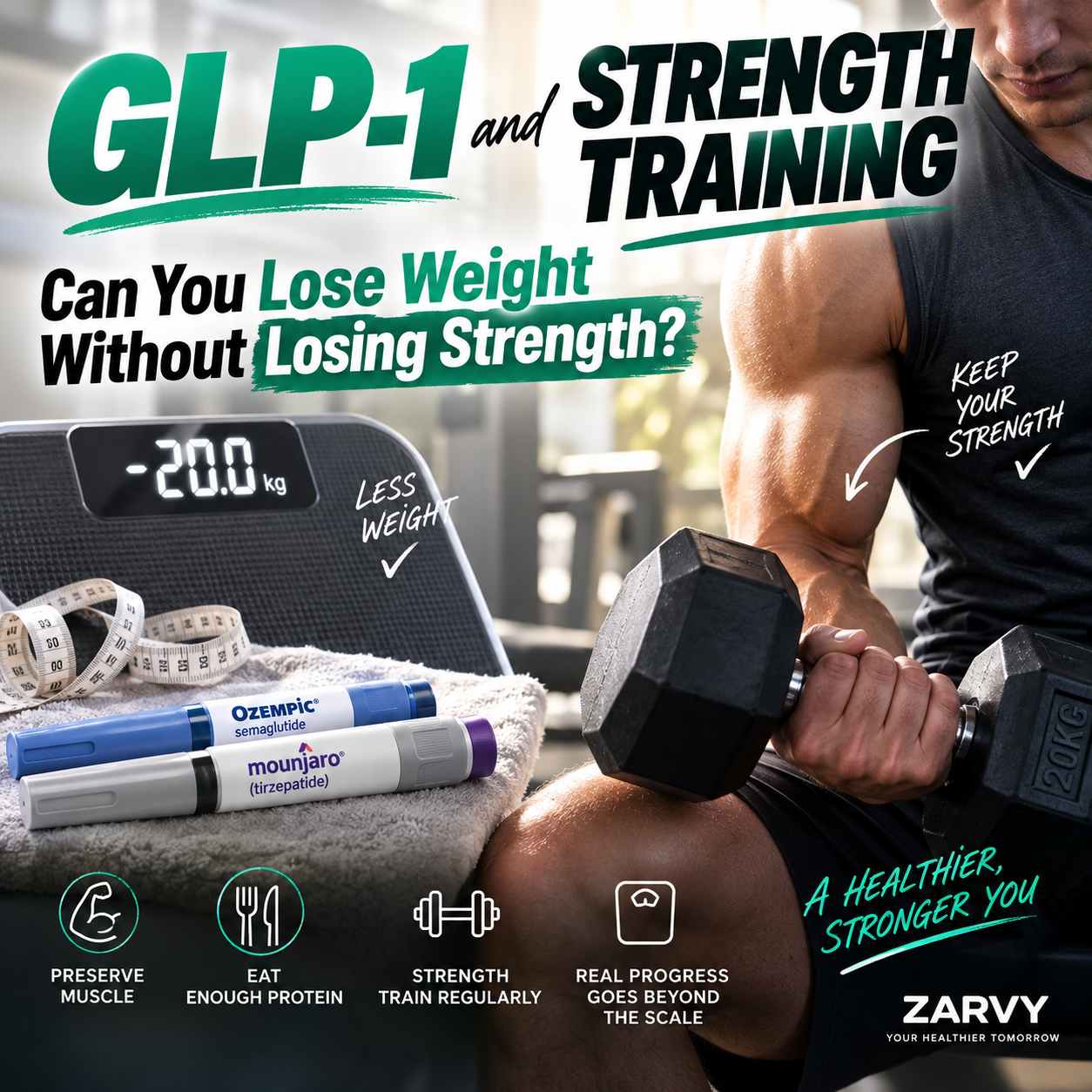
Minus 20kg.
But physically, those are two very different results.
This is why researchers are increasingly talking about the quality of weight loss, not simply the quantity.
A 2026 review on GLP 1 based obesity treatment argued that successful weight loss should not be judged by kilograms alone. Muscle mass, physical function, nutrition and metabolic health also matter.
In other words:
The goal is not just to become a smaller human.
The goal is to become a healthier one.
This Is Where Strength Training Suddenly Becomes Very Interesting
Here is perhaps the most useful number from the recent research.
In that 2026 meta analysis, ordinary lifestyle interventions had about 26.2 percent of total weight loss coming from lean mass.
But lifestyle interventions that included resistance training showed a substantially lower proportion:
17.5 percent.
That does not mean we can automatically promise the exact same number to every person taking semaglutide or tirzepatide.
The research is not that simple.
But it strongly reinforces something exercise science has been telling us for years.
If your body receives a reason to keep muscle, it has a better chance of keeping it.
And lifting weights is a very loud reason.
Think of Muscle as an Expensive Employee
Your body is constantly deciding where to spend resources.
Muscle is useful.
But muscle is also metabolically expensive tissue to maintain.
Now imagine you dramatically reduce your calorie intake.
Your body notices.
Food is coming in more slowly.
Energy intake is lower.
Body weight is falling.
If you are also sitting on the sofa all day doing absolutely nothing that requires much muscle, your body has less reason to prioritize maintaining all of that tissue.
But now imagine that three times every week you tell your muscles:
We still need you.
You squat.
You press.
You row.
You pull.
You carry something heavy.
Suddenly those muscles have a job.
That is essentially what resistance training provides during weight loss:
a reason to stay.
Do You Need to Become a Bodybuilder?
Absolutely not.
This is where people often overcomplicate things.
You do not need a six day bodybuilding split.
You do not need to spend two hours every evening screaming at a barbell.
And you definitely do not need to turn your entire personality into chicken breast and dumbbells.
Resistance training can be surprisingly simple.
Squats or leg presses.
Rows.
Chest presses or push ups.
Hip hinge movements.
Overhead presses.
Pulldowns.
Machines.
Dumbbells.
Resistance bands.
Even properly designed home workouts can create meaningful muscular tension.
The important part is that your muscles regularly encounter resistance that challenges them.
Consistency matters much more than looking like a professional athlete on Instagram.
But What About Strength?
Here is another distinction worth understanding.
Muscle mass and strength are related, but they are not identical.
A person can lose some lean mass without losing strength in exactly the same proportion.
Strength depends on several things.
Muscle size matters.
But so do technique, nervous system efficiency, coordination, training experience and familiarity with a movement.
This is one reason the conversation should not stop at a body composition scan.
Ask yourself practical questions too.
Can I still carry the same groceries?
Can I still climb stairs easily?
Can I still do the same number of push ups?
Are the weights I use in the gym roughly stable?
Do everyday physical tasks feel easier or harder?
Your body is not just something to look at.
It is something you use.
There Is Another GLP 1 Problem People Forget About
You may simply stop eating enough.
This sounds almost ridiculous.
After all, reducing appetite is one of the reasons these medications can help with weight management.
But imagine your appetite becomes much smaller.
Previously you ate:
Breakfast.
Lunch.
Dinner.
Maybe snacks.
Now you eat a little at lunch and suddenly realize at 8 PM that you barely ate anything else.
Your calories dropped.
Great for the scale.
But what happened to your protein?
That can drop too.
And if you are simultaneously trying to preserve muscle, that becomes relevant.
This is why nutrition researchers are paying increasing attention not only to calories during GLP 1 treatment, but also to protein intake, micronutrients and overall food quality.
Protein Becomes More Important When You Are Eating Less
Here is an easy way to think about it.
If you normally eat 2,500 calories per day, you have plenty of opportunities to consume protein.
If your appetite drops dramatically and you are suddenly eating much less food, every meal has more responsibility.
You probably do not want most of your limited appetite going toward foods that provide very little nutritional value.
That does not mean you need to carry protein powder everywhere you go.
It means the food you actually eat should count.
Eggs.
Fish.
Meat.
Greek yogurt.
Dairy.
Soy.
Beans and legumes.
Or other protein rich foods that fit your diet.
The exact amount a person needs depends on body size, age, health, activity and other factors.
But the basic idea is easy:
If you are eating less food, do not accidentally eat less nutrition too.
Scientists Are Now Testing This Directly
This topic has become important enough that researchers are now running a trial specifically around it.
The LEAN PREP study is examining adults with obesity beginning semaglutide or tirzepatide therapy.
Researchers are comparing four approaches:
usual treatment, resistance exercise, increased protein intake, and resistance exercise combined with increased protein.
They plan to measure quadriceps muscle size, body composition, strength and physical function.
That is fascinating because it shows how the GLP 1 conversation is evolving.
A few years ago the question was mostly:
How much weight can these medications help people lose?
Now researchers are asking:
Can we make that weight loss better?
The trial is still ongoing, so we should not pretend we already know its results. ClinicalTrials.gov currently lists the study as recruiting.
But the question itself tells us where obesity research is heading.
What If You Already Lift Weights?
This group may have an especially interesting experience.
Imagine someone who has spent years building muscle.
They begin tirzepatide or semaglutide for an appropriate medical reason and their body weight starts dropping quickly.
Their first instinct might be:
I am getting smaller. I must be losing all my muscle.
Not necessarily.
If your waist is shrinking, body fat is falling and your gym performance remains reasonably stable, the mirror and scale can be misleading.
You may simply be seeing a leaner version of yourself.
This is why lifters should probably pay attention to more than body weight.
Waist circumference.
Strength.
Training performance.
Body composition when available.
Energy levels.
Recovery.
Those tell a much richer story than one lonely number on a bathroom scale.
And No, You Probably Should Not Panic Over Every Bad Workout
Strength fluctuates.
You slept badly.
You are stressed.
You ate less carbohydrate than usual.
You trained hard yesterday.
You are dehydrated.
You simply had a terrible Monday.
One weak gym session does not prove you are losing muscle.
Look for trends.
If the same weights gradually become harder week after week while your body weight is dropping rapidly and your food intake has collapsed, that deserves attention.
But if your weight is falling, waist is shrinking and your major lifts are mostly holding steady?
That is a very different picture.
The Bathroom Scale Needs a Coworker
The scale is useful.
Just stop asking it to do every job.
Think of it as one employee in your health department.
Let the scale measure weight.
Let your waist measurement track size.
Let your gym log track strength.
Let your food intake tell you whether you are eating adequately.
Let your energy levels and physical function tell you how your body actually feels.
Suddenly you have a much better picture.
So Can You Lose Weight Without Losing Strength?
Potentially, yes.
But there is no guarantee that every person will maintain every kilogram of lean mass or every bit of strength during major weight loss.
Current evidence shows that significant weight reduction with GLP 1 based treatments can include some loss of lean mass.
It also shows something encouraging.
Most of the weight lost with tirzepatide in the SURMOUNT 1 body composition analysis came from fat, not lean mass.
And broader evidence suggests resistance training can meaningfully improve the lean mass side of the equation during weight loss.
That changes the conversation.
Instead of asking:
“Will GLP 1 make me lose muscle?”
A better question may be:
“What am I doing while I lose weight to give my body a reason to keep muscle?”
The Future of GLP 1 Weight Loss May Be About Quality, Not Just Quantity
Semaglutide and tirzepatide have already demonstrated that substantial weight loss is possible for many people with obesity or overweight under appropriate medical care.
Now the next chapter is beginning.
Researchers are looking beyond kilograms.
How much fat disappeared?
How much lean tissue remained?
Did strength stay stable?
Did physical function improve?
Is the person eating properly?
Can they maintain the result?
That is a much more interesting definition of success.
Because ultimately nobody gets excited about losing 20kg just so they can become 20kg lighter and physically weaker.
The ideal outcome is different.
Less unnecessary body fat.
As much useful muscle as possible.
Better health.
Better movement.
And a body that does more than simply produce a smaller number on a scale.
That is why strength training may become one of the most important companions to the GLP 1 weight loss era.
The injection may help change the number on the scale.
But your muscles still need a reason to stay.
Sources
2026 Lean Mass Meta Analysis on PubMed