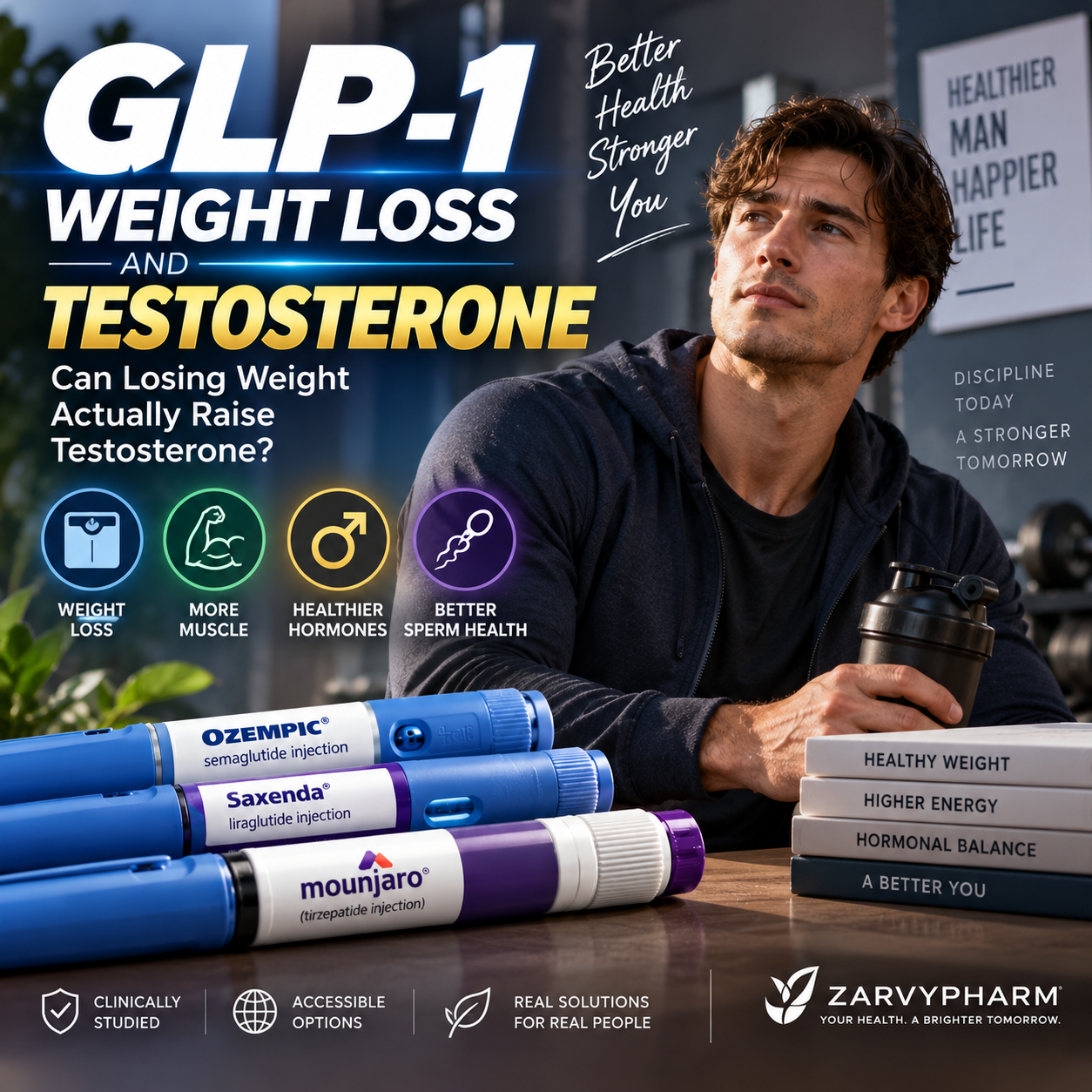
Most people know GLP 1 medications for two things.
Blood sugar control and weight loss.
Semaglutide and liraglutide have become familiar names, and newer treatments have pushed the conversation around medical weight management even further.
But there is another part of the story that gets far less attention.
What happens to testosterone when a man loses a significant amount of excess weight?
And there is an even more interesting question.
Could better metabolic health also affect male fertility and sperm health?
At first, it might sound like we are connecting two completely different subjects.
Weight loss on one side.
Testosterone and male reproductive health on the other.
But biologically, they are much more connected than you might think.
Recent research suggests that GLP 1 treatment, weight loss and testosterone may have an interesting relationship, particularly in men with obesity, type 2 diabetes or functional hypogonadism.
So let’s look at what is actually happening.
First, Why Would Body Fat Have Anything to Do with Testosterone?
This is where the story really starts.
Testosterone does not exist in its own little bubble.
Your hormonal system is connected to body composition, insulin sensitivity, sleep, inflammation and overall metabolic health.
And obesity is strongly associated with lower testosterone in men.
For some men, this can contribute to what researchers call functional hypogonadism.
The word sounds complicated.
The basic idea is not.
Imagine a man who has gained a significant amount of weight over several years.
His metabolic health gets worse.
His insulin sensitivity changes.
His sleep may get worse.
His activity level may decline.
And somewhere along the way, his testosterone comes back lower than it used to be.
That does not necessarily mean his body has permanently lost the ability to produce testosterone.
Part of the hormonal suppression may be connected to the metabolic environment itself.
And that creates a very interesting possibility.
If you improve the metabolic environment, could testosterone recover too?
So Can Losing Weight Actually Raise Testosterone?
In some overweight and obese men, yes.
This relationship existed long before GLP 1 medications became famous.
Weight loss has been associated with improvements in testosterone, particularly when excess body fat and metabolic dysfunction are contributing to lower hormone levels.
And this is where medications such as semaglutide and liraglutide become especially interesting.
GLP 1 receptor agonists can produce meaningful weight loss in many patients while also improving blood glucose control and other aspects of metabolic health.
Researchers therefore started asking a pretty obvious question.
If GLP 1 treatment improves the conditions associated with low testosterone, does testosterone improve as well?
Increasingly, the answer appears to be that it can.
What Does the New Research Actually Show?
Recent systematic reviews have started putting the pieces together.
One 2026 review examined studies involving men with obesity, type 2 diabetes and functional hypogonadism.
Across the available research, GLP 1 receptor agonist treatment was associated with modest improvements in testosterone and some reproductive measures.
Another systematic review involving 639 men examined medications including liraglutide, semaglutide, dulaglutide and exenatide.
The researchers found that GLP 1 treatment was consistently associated with increases in total testosterone, particularly in men whose metabolic health was already compromised.
That is the important part.
We are not talking about taking a man with perfectly normal testosterone and magically turning his body into a testosterone factory.
The effect seems much more interesting in men who start from a metabolically unhealthy position.
But Is It the Drug or the Weight Loss?
Now we get to the million dollar question.
Imagine someone loses a substantial amount of weight while taking semaglutide.
His testosterone increases.
What caused it?
Was it the medication?
Was it the weight loss?
Was it improved insulin sensitivity?
Was it the reduction in excess body fat?
Or was it a combination of everything?
The simplest explanation looks something like this:
GLP 1 treatment → weight loss → improved metabolic health → improved hormonal environment
And weight loss almost certainly plays an important role.
But researchers are investigating whether GLP 1 signaling itself could also influence the hormonal system involving the brain, pituitary gland and testes.
Some recent analyses have suggested that there may be effects beyond weight loss alone.
That possibility is fascinating.
But the science is not mature enough yet to say that GLP 1 medications directly increase testosterone in every man.
For now, the clearest benefits appear to be concentrated among men with obesity, metabolic dysfunction or functional hypogonadism.
What Happens if Your Testosterone Is Already Normal?
This part actually tells us a lot.
If GLP 1 medications were simply testosterone boosters, you would expect testosterone to rise dramatically in almost everyone taking them.
That is not what researchers are seeing.
Healthy men with normal reproductive hormone function have not consistently demonstrated the same hormonal improvements.
And that gives us a useful way to think about the whole subject.
GLP 1 treatment may not be pushing testosterone beyond normal physiology.
Instead, in some metabolically unhealthy men, weight loss and metabolic improvement may help a disrupted hormonal system move toward a healthier state.
That is a very different concept from taking something specifically to increase testosterone.
And Then There Is Male Fertility
This is where things get even more interesting.
Testosterone gets most of the attention, especially among men who train.
But testosterone is only one piece of male reproductive health.
What about sperm?
Recent research has started looking at that too.
Some studies involving obese or hypogonadal men receiving GLP 1 receptor agonists have reported improvements in selected semen parameters.
Researchers have also looked at LH and FSH, two hormones that play important roles in male reproductive function.
In several studies these hormones were generally preserved or increased rather than being suppressed.
That is interesting because it creates an important distinction between improving metabolic health and simply supplying testosterone from outside the body.
GLP 1 Treatment Is Not Testosterone Therapy
This distinction matters.
A GLP 1 medication is not testosterone.
If testosterone rises following substantial weight loss and metabolic improvement, that is biologically different from injecting or otherwise taking testosterone from an external source.
External testosterone can suppress LH and FSH and can reduce sperm production.
GLP 1 treatment works through a completely different pathway.
The current evidence suggests that improving obesity and metabolic dysfunction may allow natural reproductive hormone function to improve in certain men.
That does not make GLP 1 medications fertility treatments.
But it certainly makes the research interesting.
Does This Mean GLP 1 Is Good for Building Muscle?
Not so fast.
This is where a good headline can turn into a bad conclusion.
Higher testosterone sounds great if you care about muscle.
But substantial weight loss can involve both fat and lean tissue.
The goal is obviously to lose as much unwanted fat as possible while preserving muscle.
That still makes resistance training, adequate nutrition and sufficient protein important during a major weight loss phase.
So even if testosterone improves, GLP 1 medications should not suddenly be viewed as bodybuilding drugs.
That is not what these studies are telling us.
The much more interesting takeaway is this:
Improving metabolic health may allow your own hormonal environment to function better.
What If You Are Overweight and Your Testosterone Is Low?
This is probably the group that should find the research most interesting.
If excess body fat and metabolic dysfunction are contributing to lower testosterone, meaningful weight loss may improve more than the number you see on the scale.
Blood glucose control may improve.
Insulin sensitivity may improve.
Body composition may improve.
And for some men, testosterone and other aspects of reproductive hormone function may improve too.
But low testosterone has many possible causes.
That is why a low testosterone result should not automatically be blamed on body weight.
And GLP 1 medications should not be viewed as universal treatments for testosterone deficiency.
Proper evaluation still matters.
The Price Question Is Becoming Part of the GLP 1 Conversation Too
There is another reality that anyone following GLP 1 medications has probably noticed.
Cost matters.
As semaglutide and liraglutide have become increasingly popular, more consumers are looking beyond the most recognizable brand names and comparing legitimate generic or alternative products containing the same active ingredient where those options are legally available.
For price conscious consumers, generic liraglutide and semaglutide options can offer a considerably more accessible route than some branded products.
That does not mean every inexpensive product is automatically equivalent.
The active ingredient, manufacturer, storage conditions, authenticity and supply chain still matter, especially with injectable medicines.
Price should be part of the decision, not the only decision.
And What About Japanese Mounjaro?
Another option attracting attention from price conscious consumers is Japanese market Mounjaro.
Mounjaro contains tirzepatide and is different from semaglutide and liraglutide, but it has become another major name in modern metabolic and weight management treatment.
For consumers who find the cost of treatment difficult to manage, Japanese market Mounjaro can sometimes offer an attractive price proposition depending on the dose, source and market availability.
The important consideration is not simply that a product comes from Japan.
What matters is that patients can verify the product, manufacturer, authenticity, storage requirements and legitimate supply chain.
For injectable medicines in particular, appropriate storage and handling should never become secondary considerations simply because a product is cheaper.
So, Can Losing Weight Actually Raise Testosterone?
For some men, the answer appears to be yes.
And the effect seems particularly relevant when obesity and metabolic dysfunction are contributing to suppressed testosterone.
Recent research suggests that GLP 1 receptor agonists may be associated with improvements in total or bioavailable testosterone and potentially certain aspects of male reproductive function in these populations.
But there is an important difference between saying:
GLP 1 drugs boost testosterone
and saying:
Weight loss and metabolic improvement during GLP 1 treatment may help testosterone recover in some men whose hormonal function was already impaired.
The second statement is much closer to what the evidence currently supports.
The Bottom Line
GLP 1 medications first became widely known for diabetes.
Then came the weight loss revolution.
Now researchers are beginning to ask what happens beyond the scale.
For men with obesity, type 2 diabetes or functional hypogonadism, emerging evidence suggests that GLP 1 treatment and significant weight loss may be associated with improvements in testosterone and potentially certain aspects of male reproductive health.
That does not make semaglutide or liraglutide testosterone boosters.
It does not make them fertility drugs.
And it certainly does not mean every man will experience the same hormonal changes.
But it does reveal something important about the human body.
Metabolic health and hormonal health are deeply connected.
And for some men, losing excess weight may do considerably more than shrink the waistline.
It may help the body’s own hormonal system move back toward a healthier balance.