The Narrative Everyone Has Heard Before
“You’re not a horse.”
“You’re not a dog.”
“You’re not a doctor.”
You’ve probably seen these before.
The moment anthelmintic drugs get mentioned in the context of cancer, these reactions show up almost automatically.
But here’s one simple question:
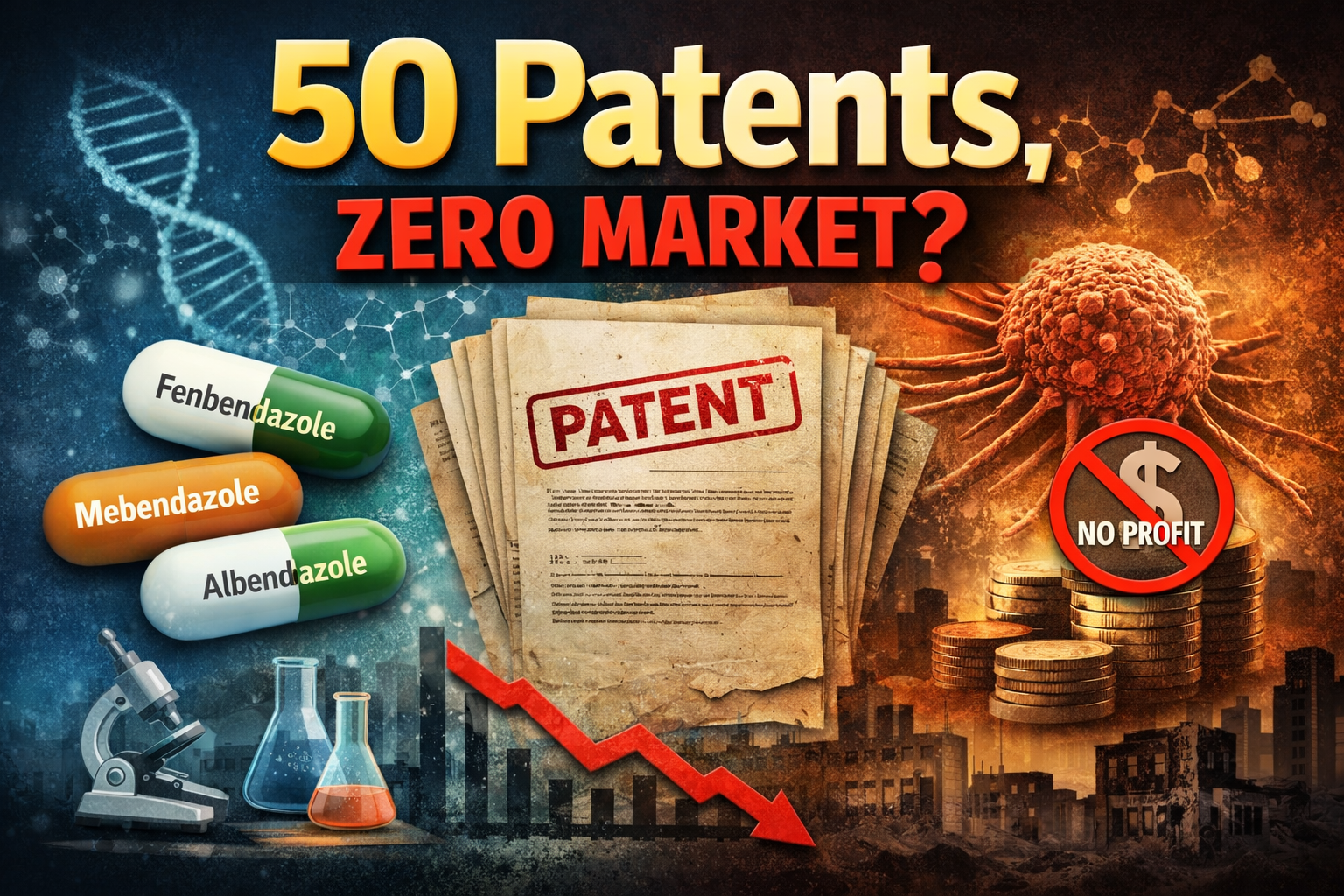
If there is truly zero basis, why have patents been filed continuously for over 50 years?
What Are We Actually Talking About?
At the core, it’s simple.
All of these belong to the benzimidazole family.
Originally developed as antiparasitic drugs, but they share key characteristics:
- Microtubule inhibition (disrupts cell division)
- Preferential impact on rapidly dividing cells
- Potential immunomodulatory effects
This is exactly why they keep reappearing in cancer-related research.
The First Signal: 1976 Patent
This isn’t a recent trend.
The first patent dates back to 1976 in France:
- “Benzimidazolyl carbamates promoting the regression of neoplastic disorders”
If it had stopped there, it would’ve been forgotten.
But it didn’t.
50 Years, 50+ Patents: Not a Coincidence
This is not an isolated case. It’s a pattern.
Looking at the timeline:
- Procter & Gamble → leukemia treatment & tumor inhibition (1996–2002)
- University of Texas System → antiparasitic drugs for hyperproliferative diseases (2002)
- Johns Hopkins University → mebendazole-based cancer approaches (2016 onward)
- South Korea, China, UK, Taiwan → nanoparticles, combination therapies, immune modulation (2015–2025)
Key takeaway:
👉 Big pharma + universities + national research institutions
👉 Continuous activity over decades
This is not something you can explain away as coincidence.
Then Why Is There No Real Market?
Now the critical question:
Why is there still no market?
The reasons are actually straightforward.
1. Patent Structure Problem
- Most of these drugs are already generic
- Hard to secure exclusivity → poor investment incentives
2. Clinical Cost vs ROI
- Cancer approval requires massive clinical trials
- But the drug price is too low → weak return
3. Positioning Issue
- “Veterinary / antiparasitic drug” stigma
- Difficult to reposition in mainstream oncology
What Is Actually Being Studied?
Looking at the patents, the direction is consistent:
1. Direct Anticancer Activity
- Inhibition of cell division
- Tumor growth suppression
2. Combination Therapy
- Combined with existing chemotherapy
- Synergistic effects
3. Immunomodulation
- Altering tumor microenvironment
- Potential immune system enhancement
4. Formulation Improvements
- Nanoparticles
- Bioavailability enhancement
- Prodrug development
So this is not just “internet theory”
→ There is a structured research track
The Gap Between Research and Reality
Here’s the real structure:
- Research: exists (and consistently)
- Patents: exist (50+)
- Market: doesn’t exist
This kind of gap usually appears when:
👉 Profit potential is low
👉 Regulatory barriers are high
👉 It conflicts with existing industry structure
What This Means (No Hype, Just Facts)
No need to overhype it.
But it’s also hard to dismiss.
The reality is:
- It’s not “baseless”
- It’s not “established treatment” either
It sits right in between.
👉 A research-active area that hasn’t translated into a market
Final Take
50 years of repeated patents tell you one thing:
This is not a one-time trend. It’s a continuously explored field.
But markets operate differently.
- Science ≠ market
- Patent ≠ product
- Possibility ≠ standard of care
Understanding this distinction is key.