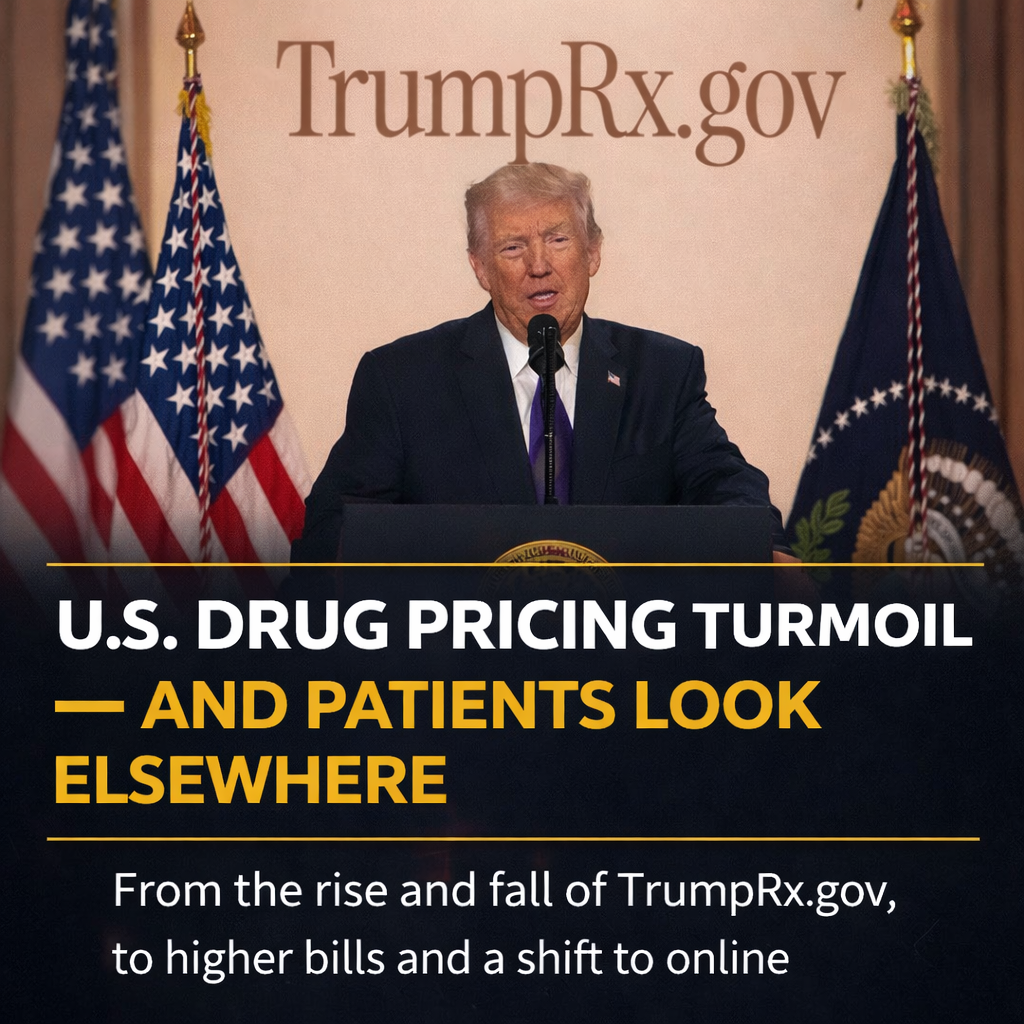
The Promise: TrumpRx and the “End of Overpriced Medicine”
In early 2026, Donald Trump launched a major initiative aimed at addressing what he described as a fundamentally broken U.S. drug pricing system.
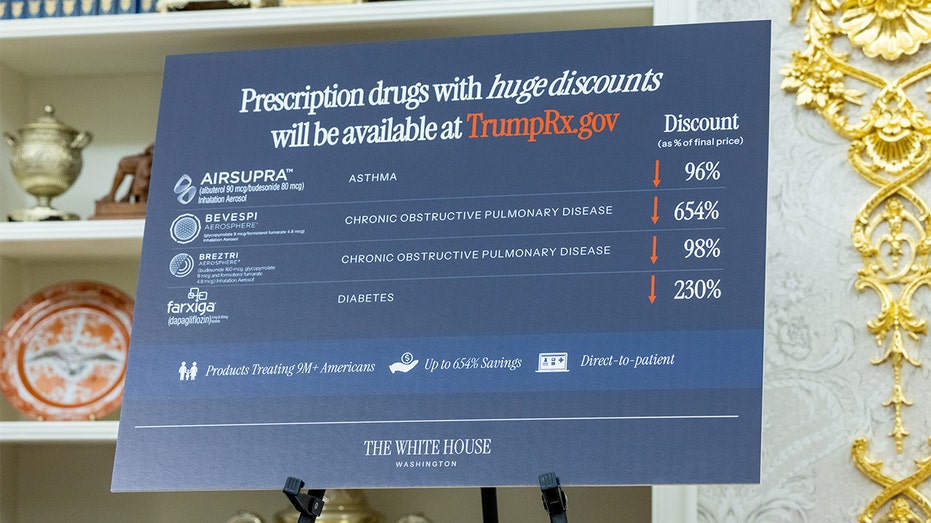
At the center of this effort was TrumpRx.gov, a government-backed platform introduced with a bold claim:
The United States would finally achieve the lowest drug prices in the developed world.
The strategy was relatively straightforward:
- Offer tariff exemptions to pharmaceutical companies
- In exchange for lower drug prices in the U.S.
- Deliver those prices through a direct-to-consumer (DTC) platform
A total of 16 major pharmaceutical companies participated, including:
AstraZeneca
Pfizer
Eli Lilly
Novo Nordisk
The most visible example was in GLP-1 obesity drugs,
where prices were expected to drop from over $1,000 per month to around $149–$350.
Initially, the announcement generated significant optimism.
The Reality Check: Not Cheaper Than the UK
However, by March 2026, the data told a different story.
According to Reuters,
TrumpRx did not consistently offer lower prices than other developed countries.
Key findings:
- About one-third of listed drugs were cheaper in the UK
- Some medications were 67%–82% less expensive in the UK
- Notable examples include:
- Farxiga (Active ingredient: Dapagliflozin) — Diabetes
- Xeljanz (Active ingredient: Tofacitinib) — Rheumatoid arthritis
- Advair Diskus (Active ingredients: Fluticasone + Salmeterol) — Respiratory diseases
In other words, the promise of “lowest prices globally” did not hold under real-world comparison.
Structural Flaw: A “Coupon Book,” Not a Real Fix
The deeper issue lies in the structure of TrumpRx itself.

The platform:
- Does not sell drugs directly
- Redirects users to external providers
- Focuses on cash-pay pricing, separate from insurance systems
As a result, analysts described it as:
A high-cost drug “coupon book” rather than a systemic pricing solution
Additional limitations:
- No integration with insurance benefits
- Discounts do not count toward deductibles
- Limited real-world impact for insured patients
In short, it did not address the core drivers of high U.S. drug prices.
And Then… It Quietly Faded Into the Background
The bigger issue came afterward.
Despite its high-profile launch, TrumpRx gradually faded from the spotlight
and continues to operate in a much more limited and less influential capacity.
Rather than becoming a central solution for drug pricing,
it now functions more as a secondary reference tool.
Crucially, there has been no significant policy expansion or enforcement mechanism,
leaving the initiative far from its original ambition.
War Spending vs. Healthcare Budget — The Real Pressure Point
At the same time, rising tensions involving Iran
have added further pressure to U.S. federal spending.
This has direct implications for healthcare.
Programs such as:
Medicare
Medicaid
are facing increasing financial strain,
with more responsibility being shifted to individual states.
The pattern becomes clear:
- Increased military spending
- Federal budget pressure
- Cost shifting to healthcare systems
- Declining policy consistency
The Reality: Even Insured Patients Still Pay High Prices
For patients, the situation is far simpler.
Even with insurance, costs remain high.
A clear example is the insulin pen.
Despite identical manufacturing, ingredients, and dosage,
U.S. prices are often several times higher than those in other countries.
On average, Americans pay around three times more for prescription drugs
compared to other developed nations.
Additionally, for well-known insulin pen brands,
online pharmacies are often reported to offer prices at least 5 times, and in some cases up to 10 times lower than those in the United States, which has led to a steadily increasing demand for insulin pen purchases through online pharmacy channels.
Even after insurance coverage,
out-of-pocket costs remain a significant burden.
For many patients, this leads to delayed or discontinued treatment.
Why More Americans Are Turning to Online Pharmacies
Given these conditions, the shift is predictable.
More patients are turning to online pharmacies.
The reasons are clear:
- Significantly lower prices for identical active ingredients
- Access to both branded and generic options
- Transparent pricing without insurance complexity
This trend is especially strong among patients with chronic conditions.
What Happens Next?
This situation reflects more than a single policy shortfall.
The rapid rise and quiet decline of TrumpRx,
combined with geopolitical tensions,
have raised broader concerns about policy execution and credibility.
Notably, this skepticism is no longer limited to critics—
it is beginning to emerge even within traditionally supportive groups.
The key question remains:
Can the United States truly solve its drug pricing problem?
Or will patients continue seeking alternatives outside the system?
The answer may shape the future of global pharmaceutical access.