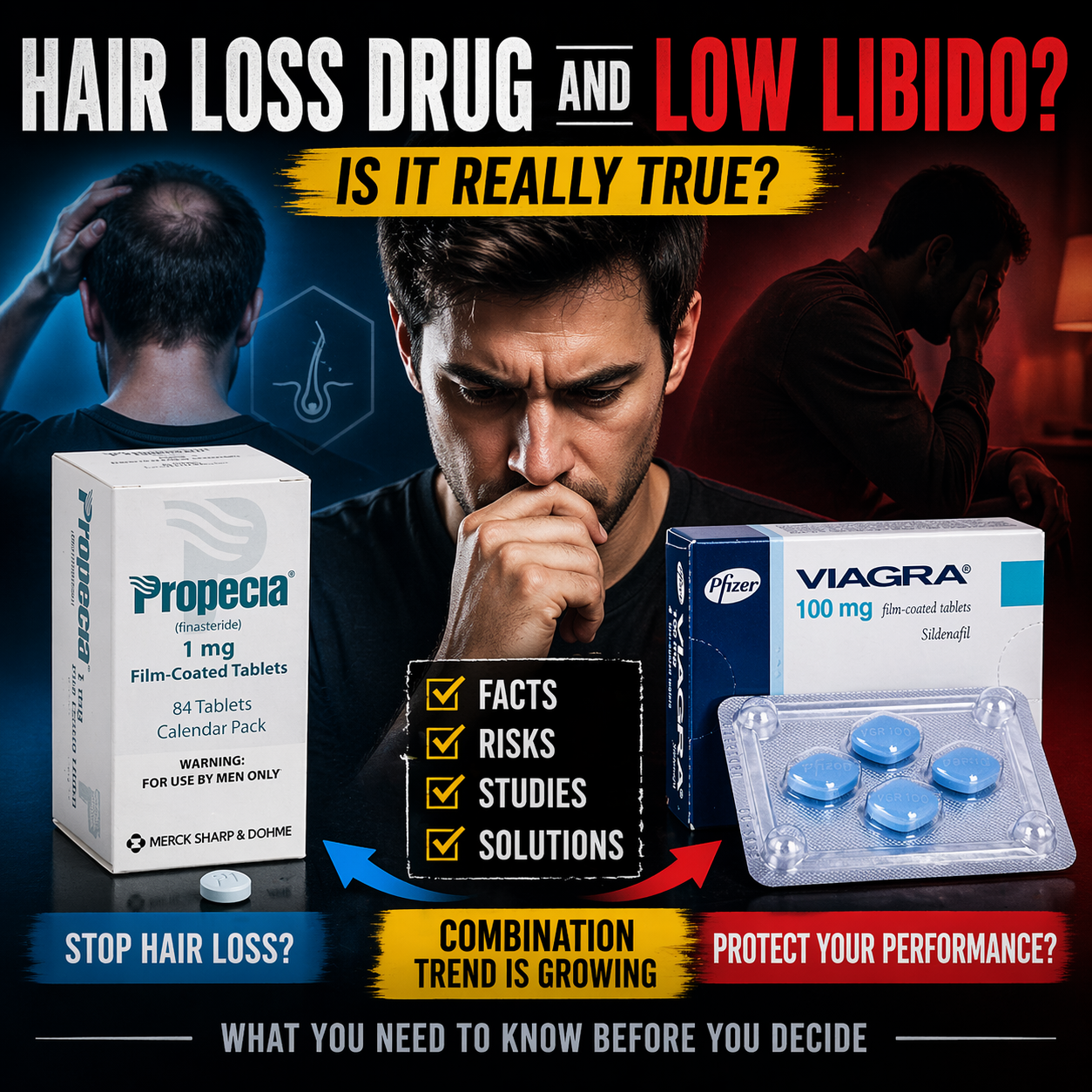
Proven Results, Ongoing Controversy
Finasteride is one of the most widely used medications for treating male pattern hair loss. Known under brand names like Propecia, it has been clinically proven to slow or even reverse hair loss in many men.
However, one question continues to come up:
Does taking finasteride reduce libido?
This topic has been debated for years, with mixed opinions from users, researchers, and regulatory authorities.
Are Sexual Side Effects Real?
The U.S. Food and Drug Administration (FDA) has updated warning labels for finasteride to include potential sexual side effects such as:
- Reduced libido
- Ejaculation issues
- Orgasm-related difficulties
More notably, some reports suggest that these side effects may persist even after discontinuing the medication.
Certain studies have also documented cases in younger men reporting:
- Erectile dysfunction (ED)
- Decreased sexual desire
- Difficulty achieving orgasm
- Psychological symptoms such as anxiety or depression
Important Context: Not Everyone Experiences This
While these reports exist, it is important to understand the scale:
- Clinical trial data suggests sexual side effects occur in approximately 2% of users
- Persistent long-term effects are estimated to be below 0.1%
Additionally, some studies have limitations:
- Small sample sizes
- Recruitment bias (participants already experiencing side effects)
In other words:
The risk exists, but it is not universally experienced and may be overstated in some discussions.
Hair Loss Treatment and ED Medication: A Growing Trend
In recent years, a noticeable trend has emerged among users:
Combining hair loss medication with ED treatments
The reasoning is straightforward:
- Users want to maintain hair growth benefits
- At the same time, they want to manage any potential changes in sexual function
In online communities, this approach is often discussed as:
- Continuing finasteride while monitoring side effects
- Using ED medication when needed rather than discontinuing treatment entirely
This reflects a broader shift:
From avoiding medication to actively managing side effects
Is Finasteride Dangerous?
The reality is more nuanced than simple claims.
- The FDA acknowledges reported side effects but has not established a definitive causal relationship
- Manufacturers maintain that finasteride is safe and effective
- Some researchers suggest the possibility of longer-term effects in a small subset of users
This leads to a balanced conclusion:
Finasteride is neither risk-free nor inherently dangerous—it depends on individual response.
What Users Actually Struggle With
Most concerns from users fall into a few categories:
- Balancing hair preservation with potential side effects
- Deciding whether to continue long-term use
- Interpreting physical or psychological changes during treatment
The most practical question becomes:
Is this medication right for me personally?
A Practical Approach
Rather than taking an all-or-nothing stance, many users adopt a more measured strategy:
- Monitoring changes in their body
- Adjusting dosage or frequency if needed
- Considering complementary approaches when necessary
Ultimately:
Individual response matters more than generalized assumptions.
Conclusion
The link between finasteride and reduced libido is not a simple yes-or-no issue.
- Some users do experience side effects
- Most users do not report significant problems
What has changed is how people approach it:
Not avoidance, but management.
Key Takeaway
Hair loss medication and libido changes are a matter of possibility, not certainty. The most important factor is how your body responds over time.