Starting an antidepressant can feel like stepping into the unknown.
When my doctor first mentioned SSRIs and SNRIs, I nodded as if I understood everything. In reality, I had no idea what those acronyms meant or how they would affect my daily life. Later that evening, I did what most people do—I opened Google and started searching.
The problem?
Most explanations felt like they were written for medical professionals rather than real people trying to make sense of their options. I wasn't looking for a neuroscience lecture. I wanted to know what these medications actually felt like. Would I feel different? Would I lose my personality? Would I finally have enough energy to get through the day?
If you're asking yourself similar questions, you're not alone.
This guide isn't meant to be a textbook. It's a practical, real-world overview of SSRIs and SNRIs, based on common patient experiences, frequently asked questions, and the realities people often discuss in online communities.
Understanding the Basics
Antidepressants are not all the same.
Two of the most commonly prescribed categories are SSRIs and SNRIs.
At first glance, the names look nearly identical. However, they affect different neurotransmitters in the brain.
What Is an SSRI?
SSRI stands for Selective Serotonin Reuptake Inhibitor.
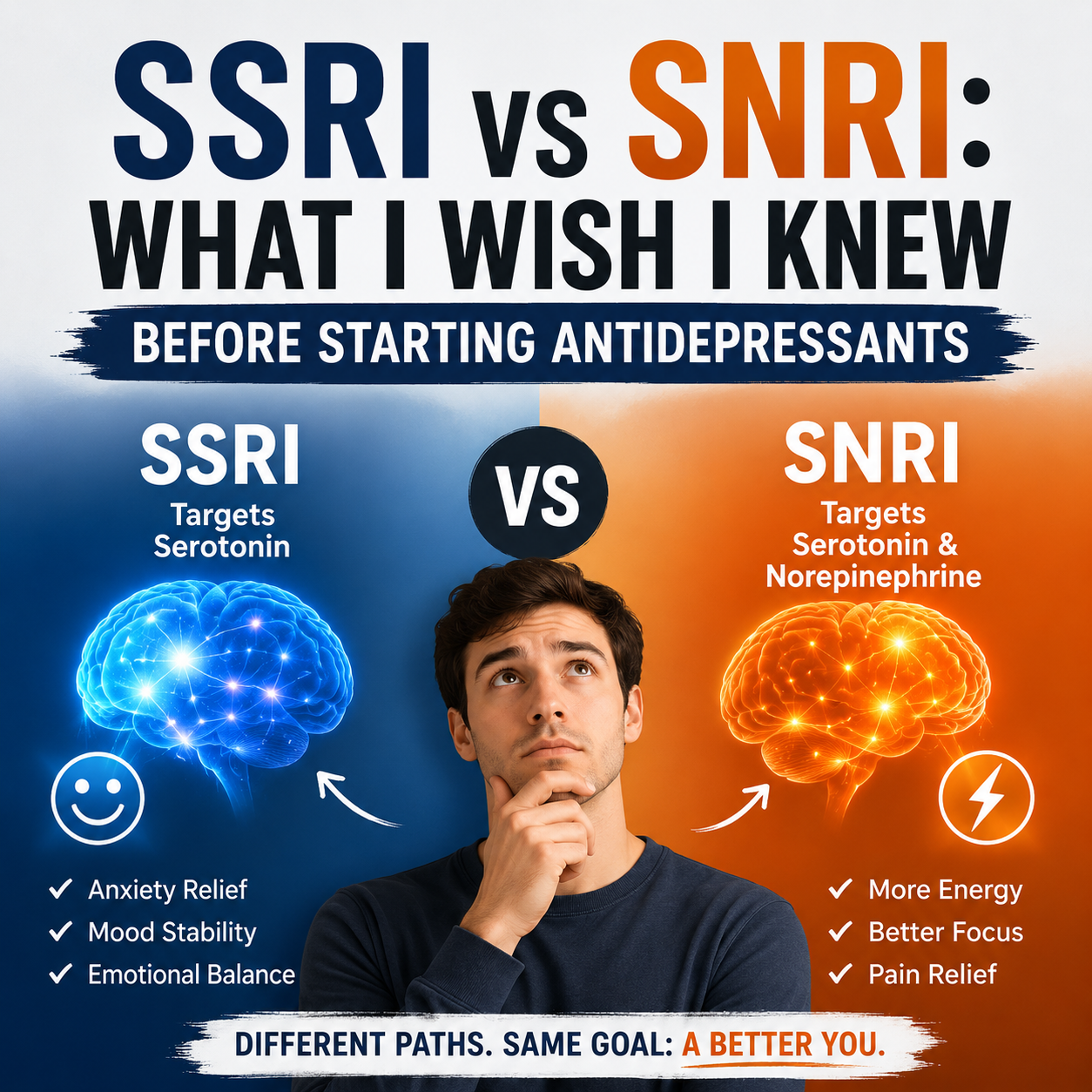
These medications work primarily by increasing serotonin activity in the brain. Serotonin plays an important role in mood regulation, sleep, emotional stability, and anxiety control.
Instead of allowing serotonin to be quickly reabsorbed, SSRIs help keep it available for longer periods, which can gradually improve mood and reduce anxiety symptoms.
Common SSRIs include:
-
Zoloft (Sertraline)
-
Lexapro (Escitalopram)
-
Prozac (Fluoxetine)
-
Paxil (Paroxetine)
SSRIs are often considered the first-line treatment for anxiety disorders and depression because they are generally well-studied and widely prescribed.
What Is an SNRI?
SNRI stands for Serotonin-Norepinephrine Reuptake Inhibitor.
Like SSRIs, they increase serotonin activity. However, they also affect norepinephrine, a neurotransmitter involved in energy levels, alertness, focus, and stress response.
Because of this dual action, SNRIs may provide benefits beyond mood stabilization, particularly for people who struggle with low energy, poor concentration, or chronic pain.
Common SNRIs include:
-
Effexor XR (Venlafaxine)
-
Cymbalta (Duloxetine)
-
Pristiq (Desvenlafaxine)
Many people describe SNRIs as offering a slightly more activating or energizing effect compared to SSRIs.
SSRI vs SNRI: The Simplest Explanation
If we remove all the medical terminology, the comparison often looks something like this:
SSRI:
-
Focuses mainly on serotonin
-
Often helps reduce anxiety and emotional distress
-
Commonly chosen for panic attacks and generalized anxiety
-
May feel more calming
SNRI:
-
Affects both serotonin and norepinephrine
-
May improve energy and motivation
-
Often considered when fatigue is a major symptom
-
Can sometimes help with chronic pain conditions
Of course, every person responds differently.
Two people can take the same medication and have completely different experiences.
What Starting an Antidepressant Actually Feels Like
One of the biggest surprises for many people is that antidepressants don't work immediately.
Unlike pain medication, you don't take a pill and suddenly feel better.
The first week can actually feel strange.
Some people report:
-
Mild nausea
-
Increased anxiety
-
Headaches
-
Sleep disturbances
-
Brain fog
-
Fatigue
This adjustment period can be frustrating because symptoms may temporarily feel worse before they improve.
For many people, things begin to stabilize after two to four weeks.
The full therapeutic effect often takes six to eight weeks.
That's much longer than most people expect.
Real Experiences From SSRI Users
When reading through forums and patient discussions, several common themes appear.
Many SSRI users describe experiences such as:
"I felt sleepy and disconnected for the first couple of weeks, but eventually my anxiety dropped dramatically."
"My panic attacks became less intense, and I could finally sleep through the night."
"I don't feel euphoric. I just feel normal again."
"My emotions are less chaotic, which is exactly what I needed."
Some users also report:
-
Reduced libido
-
Delayed orgasm
-
Emotional blunting
-
Increased appetite
Not everyone experiences these side effects, but they are among the most commonly discussed.
Real Experiences From SNRI Users
SNRI experiences often sound slightly different.
Many users say:
"It felt like the mental fog started clearing."
"I still have bad days, but I finally have enough energy to function."
"My motivation improved more than I expected."
"It surprisingly helped with chronic pain."
Common early side effects include:
-
Nausea
-
Sweating
-
Increased heart rate
-
Difficulty sleeping
-
Dizziness
For some people, the increased norepinephrine activity can feel stimulating, especially during the first few weeks.
Why Some Doctors Start With SSRIs First
Many healthcare providers prefer beginning treatment with an SSRI.
There are several reasons:
-
Extensive long-term research
-
Strong effectiveness for anxiety disorders
-
Familiar side effect profile
-
Often easier to tolerate initially
If symptoms such as severe fatigue, lack of motivation, or chronic pain remain significant concerns, an SNRI may be considered later.
This is not a strict rule, but it is a common treatment pattern.
The Topic Nobody Likes Talking About: Sexual Side Effects
One of the most frequently searched antidepressant topics online is sexual dysfunction.
Many users worry about:
-
Lower libido
-
Difficulty reaching orgasm
-
Reduced sexual sensitivity
These effects can occur with both SSRIs and SNRIs, although individual experiences vary considerably.
For some people, symptoms improve after several weeks.
For others, medication adjustments may be necessary.
It's an important conversation to have with your healthcare provider rather than silently struggling with it.
Understanding Antidepressant Withdrawal
One of the biggest mistakes people make is stopping medication suddenly because they feel better.
Antidepressants generally need to be tapered gradually.
Stopping abruptly can lead to withdrawal symptoms such as:
-
Dizziness
-
Nausea
-
Headaches
-
Anxiety
-
Insomnia
-
Mood swings
-
Electric shock sensations known as "brain zaps"
Brain zaps are often described as brief electrical sensations inside the head.
Although they can feel alarming, they are usually temporary.
The best way to minimize withdrawal symptoms is to reduce medication slowly under medical supervision.
Frequently Asked Questions
Which is better for anxiety?
SSRIs are often considered the first choice for anxiety disorders because they tend to have a stronger calming effect.
Which is better for low energy?
Many people find SNRIs more helpful when fatigue and lack of motivation are major concerns.
How long before antidepressants work?
Most people begin noticing improvements within two to four weeks, although full benefits may take six to eight weeks.
Can I drink alcohol while taking antidepressants?
Alcohol can increase side effects such as dizziness, drowsiness, and impaired judgment. Many healthcare providers recommend limiting or avoiding alcohol.
Will antidepressants change my personality?
Most users do not describe becoming a different person. Instead, many report feeling more emotionally stable and better able to manage daily life.
How Doctors Typically Choose Between SSRI and SNRI
The decision often depends on symptom patterns.
SSRI may be preferred when:
-
Anxiety is the primary concern
-
Panic attacks are common
-
Emotional overwhelm is a major issue
SNRI may be preferred when:
-
Fatigue is severe
-
Motivation is extremely low
-
Chronic pain is present
-
Concentration problems are significant
Previous medication experiences also play a major role in determining future treatment choices.
Final Thoughts: Finding the Right Fit Takes Time
One of the most important lessons I learned is that there is no universal "best" antidepressant.
Some people thrive on SSRIs.
Others respond dramatically better to SNRIs.
The goal isn't to find the medication with the best reviews online.
The goal is to find the medication that works for your brain, your symptoms, and your lifestyle.
Give the process time.
Track how you feel.
Communicate openly with your healthcare provider.
And most importantly, don't judge a medication too quickly.
Finding the right antidepressant often requires patience, adjustment, and consistency—but for many people, the improvement in quality of life makes the journey worthwhile.