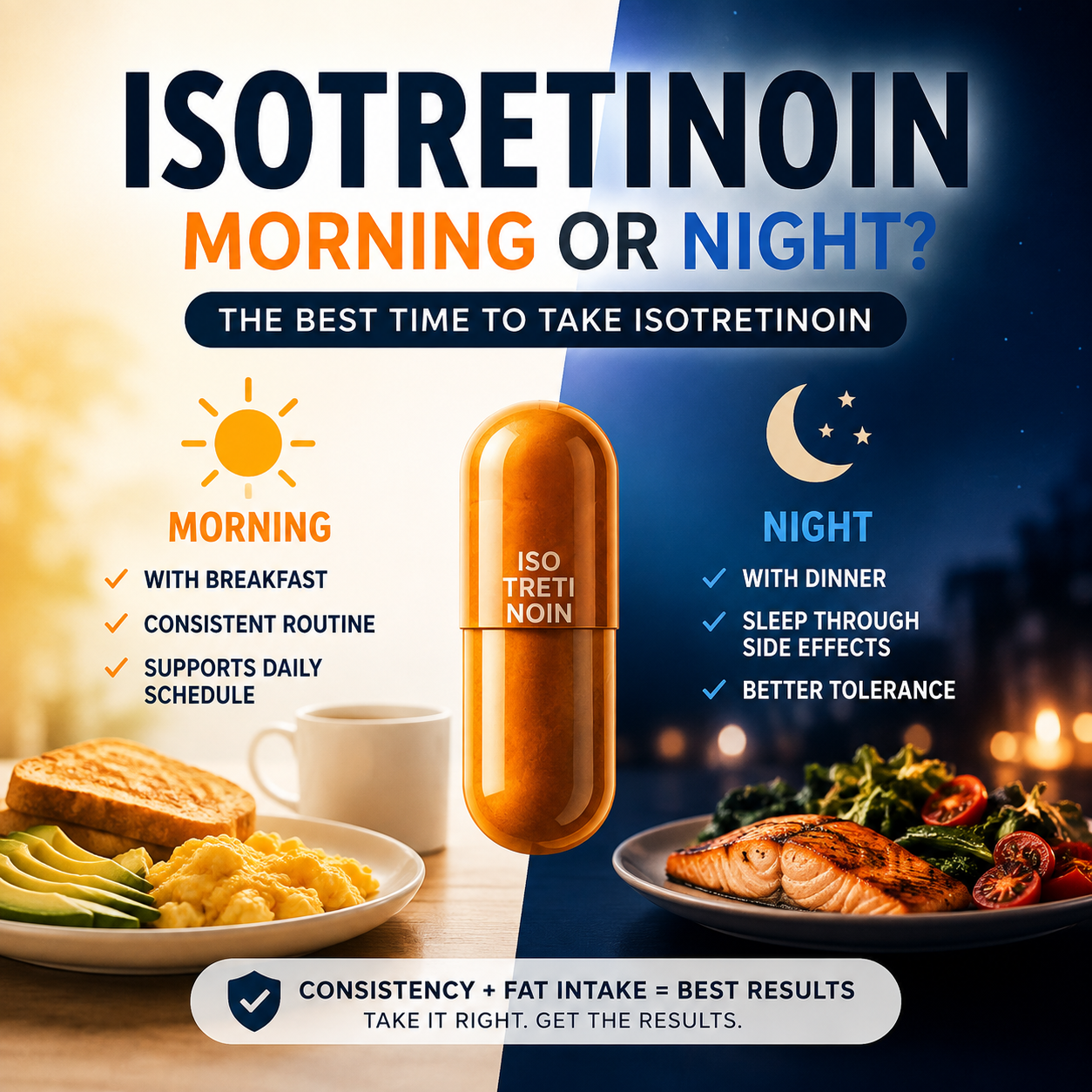
Isotretinoin is one of the most effective medications available for severe or persistent acne. But when starting treatment, one surprisingly common question comes up:
Should you take isotretinoin in the morning or at night?
For most people, there isn't one universally “perfect” hour. What matters more is taking isotretinoin consistently and following the food instructions for the specific product you are using.
For conventional isotretinoin formulations, taking the capsule with food—particularly a meal containing some dietary fat—can substantially improve absorption. Some newer formulations are less dependent on food, so the instructions supplied with your particular medicine should always take priority.
Here’s what you need to know about isotretinoin timing, meals, absorption, and building a routine you can actually maintain.
What Is Isotretinoin?
Isotretinoin is an oral retinoid derived from vitamin A. It is primarily used to treat severe, treatment-resistant, nodular, or scarring acne, although prescribing practices vary by country and individual circumstances.
It tackles acne through several mechanisms at once:
-
Dramatically reducing sebaceous gland activity and sebum production
-
Helping prevent pores from becoming clogged
-
Reducing inflammation
-
Making the skin environment less favorable for acne-associated bacteria
This combination is why isotretinoin can produce long-lasting improvement even in patients whose acne has responded poorly to conventional topical treatments or oral antibiotics.
However, isotretinoin is also a medication where correct dosing, monitoring, and consistent use matter considerably.
Does It Matter What Time You Take Isotretinoin?
Usually, the exact clock time is less important than consistency and correct administration.
In practical terms, that means choosing a time that:
-
Fits naturally into your daily routine
-
Makes it easy to remember your dose
-
Matches the food requirements of your particular formulation
-
Is comfortable based on how you personally respond to treatment
For someone taking isotretinoin once daily, breakfast or dinner can therefore both be reasonable options.
If dinner is your most substantial and consistent meal, taking conventional isotretinoin with dinner may be particularly convenient. If breakfast is easier to maintain every day, morning administration may work just as well when consistent with your product instructions.
Consistency generally matters more than whether the clock says 8 AM or 8 PM.
Why Taking Isotretinoin With Food Can Matter
One of the most important characteristics of traditional isotretinoin is that it is highly lipophilic—or fat-soluble.
Dietary fat stimulates digestive processes that can improve the absorption of lipophilic medications from the gastrointestinal tract.
For conventional isotretinoin products, studies have shown that taking the medicine with food can substantially increase systemic exposure compared with fasting administration.
This means repeatedly taking conventional isotretinoin on an empty stomach could result in lower and less predictable drug exposure.
A practical approach
Instead of obsessing over an exact amount of dietary fat every day, associate the medication with a normal, substantial meal containing some fat.
Examples might include:
-
Eggs and avocado
-
Yogurt with nuts
-
Fish with rice and vegetables
-
Chicken with olive-oil-based dressing
-
Peanut or other nut butter with a meal
-
Cheese or other dairy products
-
A regular mixed dinner containing protein, carbohydrates, and fat
You generally do not need to turn every dose into an unusually high-fat meal. The objective is reliable administration according to the formulation's instructions, not simply maximizing fat consumption.
Morning vs. Evening: Which Is Better?
There is no strong general rule establishing morning or evening as inherently superior for everyone.
Taking Isotretinoin in the Morning
Morning dosing can be convenient if breakfast is one of your most predictable meals.
It may work particularly well for people who:
-
Rarely skip breakfast
-
Already take other daily medicines in the morning
-
Find morning routines easier to remember
-
Prefer not to take medication close to bedtime
The major consideration is your breakfast itself. Someone who only drinks coffee in the morning may find dinner a more practical anchor for a conventional food-dependent isotretinoin product.
Taking Isotretinoin in the Evening
Dinner is often a convenient choice simply because it tends to be a larger and more consistent meal.
Evening dosing may therefore suit people who:
-
Eat their largest meal at dinner
-
Frequently skip breakfast
-
Have more consistent evening routines
-
Find it easier to remember medication with dinner
Importantly, you do not need to take isotretinoin at night because it supposedly works better while you sleep. The practical advantage of evening administration is mainly that dinner may provide a reliable meal and dosing routine.
Is Evening Isotretinoin Better for Side Effects?
You may encounter claims online that taking isotretinoin at night allows you to “sleep through” side effects such as headache, nausea, or fatigue.
That can be a useful personal strategy for some people, but it should not be treated as a universal pharmacological rule.
Isotretinoin's common adverse effects—including dry lips and skin—develop throughout treatment rather than appearing only during a short period immediately after swallowing each capsule.
If you personally notice temporary symptoms associated with dosing, changing the time of administration may make your routine more comfortable.
But there is no need to switch from a morning schedule that is already working well simply because evening dosing is sometimes recommended online.
The Formulation Makes a Difference
This point is frequently overlooked.
Not every isotretinoin product has identical food requirements.
Traditional formulations generally demonstrate significantly greater absorption when taken with food. Certain newer formulations have been engineered to reduce this food dependence.
For example, some micronized or lipid-based isotretinoin formulations may provide more predictable absorption under fasting conditions than conventional formulations.
Therefore, don't automatically assume that instructions for one isotretinoin brand apply perfectly to another.
Check:
-
The active ingredient
-
Formulation
-
Strength
-
Manufacturer instructions
-
Whether administration with food is specified
This becomes particularly important when switching between brands or generic manufacturers during a treatment course.
Once-Daily vs. Twice-Daily Isotretinoin
Isotretinoin dosing schedules can differ.
Some patients receive a once-daily regimen, while others may be instructed to divide the total daily dose into two administrations.
If your regimen is twice daily, the practical approach is typically to associate each dose with regular meals—for example, breakfast and dinner—according to the prescribed instructions.
Do not independently split a once-daily prescription simply because two doses appear more balanced.
Ultimately, isotretinoin treatment is based not only on the milligrams contained in each capsule but also on factors such as body weight, tolerability, clinical response, treatment duration, and the dosing strategy being used.
What If You Forget a Dose?
Missing an occasional isotretinoin dose does not usually mean you should compensate by taking twice as much.
If you remember reasonably soon, follow the missed-dose instructions supplied with your medicine. If it is already close to the next scheduled dose, the usual approach is to skip the missed dose and return to the normal schedule.
Do not double your next dose unless specifically instructed to do so.
A simple way to reduce missed doses is to connect isotretinoin with something you already do every day:
Dinner → isotretinoin → brush teeth
or
Breakfast → isotretinoin → leave for work
Building the medication into an existing habit is often more reliable than relying on memory alone.
Important Isotretinoin Precautions
Timing is only one small part of using isotretinoin correctly.
Several precautions are substantially more important.
Avoid Additional Vitamin A Supplements
Because isotretinoin is related to vitamin A, combining it with additional vitamin A supplementation can increase the risk of excessive retinoid-related adverse effects.
Always check multivitamins and supplements for vitamin A content.
Be Careful With Tetracycline Antibiotics
Concurrent use of isotretinoin with tetracycline-class antibiotics is generally avoided because of the potential increased risk of intracranial hypertension.
Expect Dryness
Dry lips are extremely common during isotretinoin treatment, while dry skin, nasal dryness, and eye irritation may also occur.
A simple supportive routine can make treatment considerably easier:
-
Lip balm or petrolatum
-
Gentle moisturizer
-
Mild facial cleanser
-
Sunscreen
-
Artificial tears when appropriate
Starting this routine early is usually easier than waiting until dryness becomes severe.
Pregnancy Prevention Is Critical
Isotretinoin can cause severe birth defects when exposure occurs during pregnancy.
Pregnancy-prevention requirements and monitoring programs differ by country, but anyone who can become pregnant must strictly follow the pregnancy-prevention measures associated with their treatment program.
Blood tests and other monitoring may also be required during treatment depending on the patient's circumstances and local prescribing standards.
Frequently Asked Questions
Is it better to take isotretinoin in the morning or at night?
Neither is universally better. Choose a time that you can maintain consistently and that matches the administration requirements of your particular isotretinoin product. For conventional formulations, dinner is often convenient because it tends to be a substantial meal.
Should isotretinoin be taken with food?
For many conventional isotretinoin formulations, yes. Food can significantly increase absorption. However, food dependence varies between formulations, so always check the instructions for the specific product.
Does isotretinoin need a high-fat meal?
Traditional isotretinoin absorption is improved by food and dietary fat, but this doesn't mean every dose requires an excessively fatty meal. A regular balanced meal containing dietary fat is a practical approach for many conventional formulations.
Can I take isotretinoin on an empty stomach?
This depends on the formulation. Conventional isotretinoin may have substantially reduced absorption when taken fasting, whereas certain newer formulations are designed to be less dependent on food.
Can I change from morning to evening?
The exact hour generally isn't the critical factor. If changing your schedule makes adherence or meal pairing easier, timing can often be adjusted while maintaining the prescribed daily regimen.
What happens if I miss an isotretinoin dose?
Do not automatically double the next dose. Follow the missed-dose instructions supplied with your medication and resume your regular dosing schedule as directed.
Can I drink alcohol while taking isotretinoin?
Both alcohol consumption and isotretinoin can affect liver function and blood lipids. Alcohol intake is therefore an important consideration during treatment, particularly when liver enzymes or triglycerides are being monitored.
Best Practical Routine for Isotretinoin
For many people taking a conventional once-daily isotretinoin formulation, the simplest routine is:
Choose one reliable meal → take the prescribed dose as directed → repeat at approximately the same point in your routine every day.
If dinner is your largest and most reliable meal, dinner is an excellent anchor.
If breakfast is more reliable, morning dosing can be equally practical.
If your particular isotretinoin formulation has different food requirements, follow those product-specific instructions instead.
The goal isn't to find a magical hour. It is to create a routine that provides consistent dosing, appropriate absorption, and good adherence throughout the treatment course.
The Bottom Line
So, when is the best time to take isotretinoin?
For most patients, morning versus evening matters less than consistency and correct administration with food when required by the formulation.
Traditional isotretinoin is fat-soluble, and taking it with an appropriate meal can significantly affect absorption. Dinner is often a convenient choice because it tends to be a larger meal, but breakfast can work perfectly well for patients with a reliable morning routine.
The biggest mistake isn't necessarily choosing morning instead of night.
It's taking isotretinoin inconsistently or ignoring the administration instructions for the specific product you're using.
A simple, repeatable routine is usually the best one—and understanding how your particular isotretinoin formulation should be taken can help you get the most from your acne treatment.